A Levels Chemistry (9701)•9701/12/O/N/21
A Levels Chemistry (9701) — 9701/12/O/N/21, Question 19
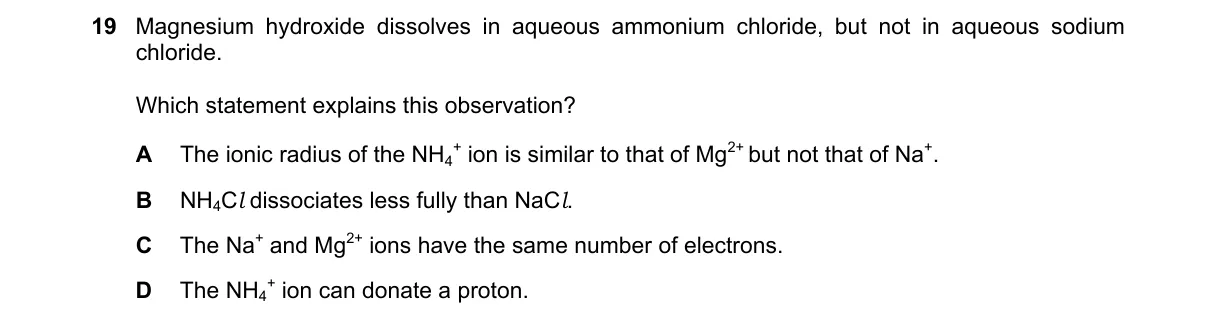
Magnesium hydroxide dissolves in aqueous ammonium chloride, but not in aqueous sodium chloride.
Answer choices
- AThe ionic radius of NH4+ is similar to that of Mg2+ but not that of Na+.
- BNH4Cl dissociates less than NaCl
- CThe Na+ and Mg2+ have the same number of electrons.
- DThe NH4+ can donate a proton.
Explanation
Ammonium ion's acidity dissolves Mg(OH)₂ via proton donation
Steps:
- Mg(OH)₂ is a sparingly soluble base that provides OH⁻ ions.
- In NH₄Cl solution, NH₄⁺ acts as a weak acid, donating H⁺ to OH⁻ to form NH₃ and H₂O.
- This reaction shifts Mg(OH)₂ dissolution equilibrium rightward, increasing solubility.
- NaCl lacks an acidic cation, so no such reaction occurs, and Mg(OH)₂ remains insoluble.
Why D is correct:
- NH₄⁺ is a Brønsted-Lowry acid (NH₄⁺ ⇌ NH₃ + H⁺), protonating OH⁻ to remove it from solution per Le Châtelier's principle.
Why the others are wrong:
- A: Ionic radius affects lattice energy but not the acid-base dissolution mechanism here.
- B: Both NaCl and NH₄Cl fully dissociate in water; dissociation extent is irrelevant.
- C: Equal electrons (10 each) implies similar size but doesn't explain selective solubility.
Final answer: D
Topic: Group 2
Practice more A Levels Chemistry (9701) questions on mMCQ.me