A Levels Chemistry (9701)•9701/12/O/N/21
A Levels Chemistry (9701) — 9701/12/O/N/21, Question 16
Silver chloride and silver iodide form equilibria when added to water. AgCl(s) ⇌ Ag+(aq) + Cl-(aq) K1 AgI(s) ⇌ Ag+(aq) + I-(aq) K2 Each equilibrium position lies to the left. Silver iodide will not dissolve in aqueous ammonia. Silver chloride will dissolve in aqueous ammonia. Ag+(aq) + 2NH3(aq) ⇌ [Ag(NH3)2]+(aq) K3 What is the order of magnitude for these three equilibrium constants? smallest → largest
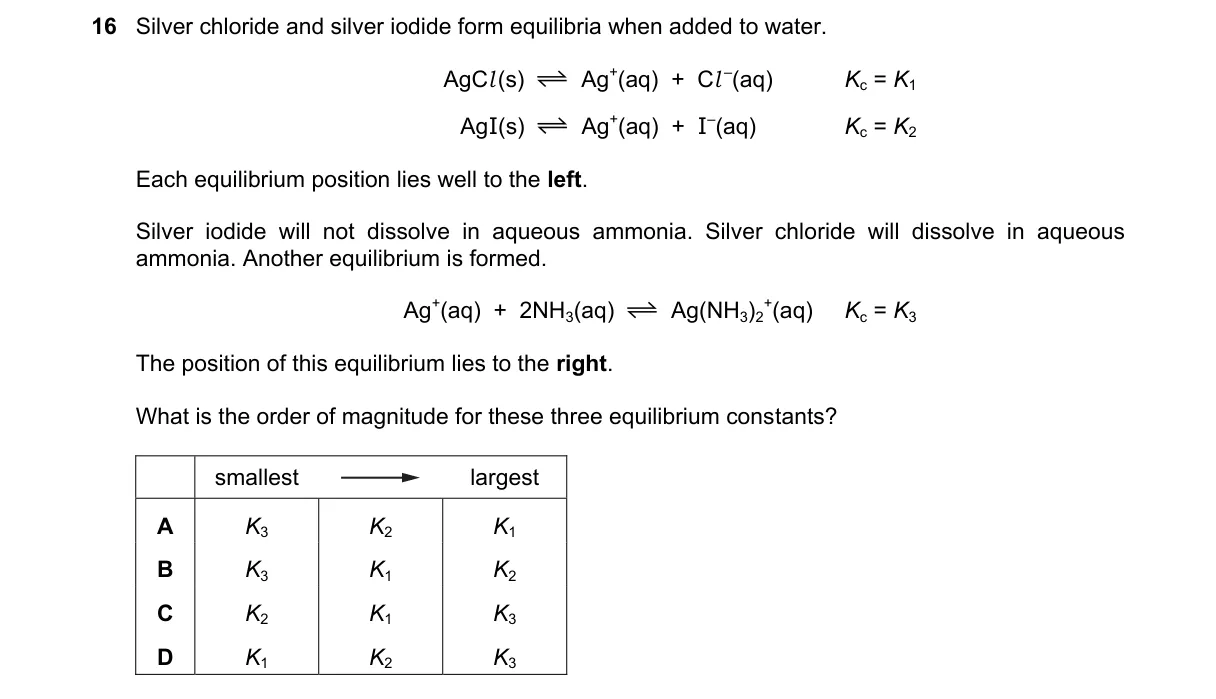
Answer choices
- AK3 K1 K2
- BK1 K3 K2
- CK2 K1 K3
- DK1 K2 K3
Explanation
Solubility and complexation dictate Ksp and Kf order
Steps:
- Equilibria lie left, so K1 and K2 (Ksp values) are small; AgCl dissolves in NH3 but AgI does not, indicating AgCl more soluble, thus K1 > K2.
- Complexation Ag⁺ + 2NH3 ⇌ [Ag(NH3)2]⁺ with K3 removes free Ag⁺, shifting dissolution right for AgCl but not AgI.
- Smaller K2 means less Ag⁺ from AgI, so even large K3 insufficient to dissolve AgI, while K1 allows effective complexation.
- Thus, K2 < K1 < K3 in magnitude.
Why C is correct:
- K2 < K1 reflects AgI's lower solubility (smaller Ksp); K3 > K1 as complex stability constant enables AgCl dissolution per Le Chatelier's principle.
Why the others are wrong:
- A: Places K3 smallest, but large K3 drives AgCl solubility via complexation.
- B: Suggests K1 < K3 < K2, contradicting K2 < K1 from solubility difference.
- D: Implies K1 < K2, but AgCl's greater solubility means K1 > K2.
Final answer: C
Topic: Equilibria
Practice more A Levels Chemistry (9701) questions on mMCQ.me