A Levels Chemistry (9701)•9701/12/O/N/21
A Levels Chemistry (9701) — 9701/12/O/N/21, Question 10
In a catalytic converter in the exhaust system of a car, carbon monoxide is oxidised to carbon dioxide, and nitrogen monoxide is reduced to nitrogen. What are the changes in oxidation number of carbon and nitrogen in these processes?
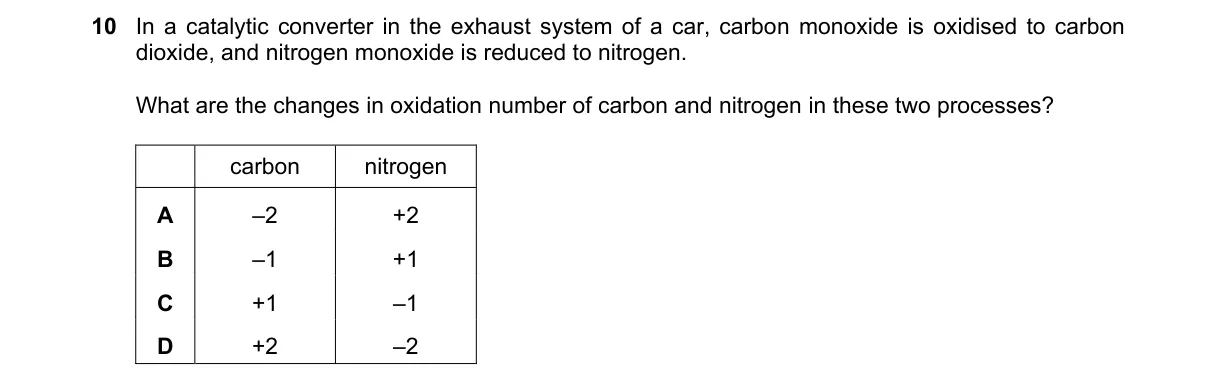
Answer choices
- Acarbon -2, nitrogen +2
- Bcarbon +1, nitrogen -1
- Ccarbon -1, nitrogen +1
- Dcarbon +2, nitrogen -2
Explanation
Oxidation Number Changes in Redox Reactions
Steps:
- Assign oxidation number to C in CO: +2 (since O is -2).
- Assign oxidation number to C in CO₂: +4 (two O atoms total -4).
- Calculate change for C: +4 - (+2) = +2 (oxidation).
- Assign oxidation number to N in NO: +2 (O is -2); in N₂: 0 (elemental form).
- Calculate change for N: 0 - (+2) = -2 (reduction).
Why D is correct:
- D states carbon +2 and nitrogen -2, matching the exact increases/decreases per oxidation number rules for redox species.
Why the others are wrong:
- A: Reverses both signs; carbon decreases, nitrogen increases—opposite of oxidation/reduction.
- B: Carbon change is +2, not +1; nitrogen -2, not -1.
- C: Carbon increases (+2), not decreases (-1); nitrogen decreases (-2), not increases (+1).
Final answer: D
Topic: Chemistry of transition elements
Practice more A Levels Chemistry (9701) questions on mMCQ.me