A Levels Chemistry (9701)•9701/11/O/N/21
A Levels Chemistry (9701) — 9701/11/O/N/21, Question 7
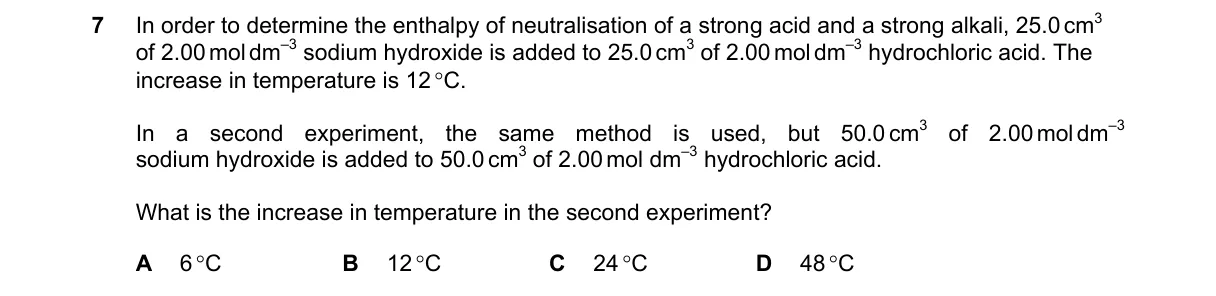
In order to determine enthalpy of neutralisation of a strong acid and a strong alkali, 25 cm³ of 2.0 mol dm⁻³ sodium hydroxide is added to 25.0 cm³ of 2.0 mol dm⁻³ hydrochloric acid. The increase in temperature is 12°C. In a second experiment the same method is used, but 50 cm³ of 2.0 mol dm⁻³ sodium hydroxide is added to 50.0 cm³ of 2.0 mol dm⁻³ hydrochloric acid. What is the increase in temperature for this second experiment?
Answer choices
- A6°C
- B12°C
- C24°C
- D48°C
Explanation
Temperature rise is independent of scale for equal concentrations
Steps:
- Calculate moles in first experiment: 25 cm³ = 0.025 dm³, so 0.025 × 2 = 0.05 mol NaOH and 0.05 mol HCl; they fully react, releasing heat for 0.05 mol neutralization.
- Total volume = 50 cm³; heat capacity proportional to volume; ΔT = 12°C.
- In second experiment: 50 cm³ = 0.05 dm³, so 0.05 × 2 = 0.1 mol each; heat doubles for 0.1 mol neutralization.
- Total volume = 100 cm³ (doubles); since heat and heat capacity both double, ΔT remains 12°C.
Why B is correct:
- Enthalpy of neutralization for strong acid-base is constant (-57 kJ/mol H₂O); q = n × ΔH, and ΔT = q / (m c), so scaling moles and mass equally keeps ΔT constant.
Why the others are wrong:
- A: Ignores doubled moles, assuming same heat but doubled mass (halves ΔT).
- C: Assumes doubled heat without doubled mass (doubles ΔT).
- D: Assumes quadrupled heat relative to mass (quadruples ΔT).
Final answer: B
Topic: Chemical energetics
Practice more A Levels Chemistry (9701) questions on mMCQ.me