A Levels Chemistry (9701)•9701/11/O/N/21
A Levels Chemistry (9701) — 9701/11/O/N/21, Question 16
In a series of nine experiments, to test the reactivity of the halogens, an aqueous solution of each halogen is added to an equal volume of an aqueous solution containing halide ions, as shown in the table. The nine test tubes are shaken separately with an equal volume of hexane. The nine test tubes are left to stand so that the aqueous and organic solvents separate into layers. How many test-tubes contain a purple upper hexane layer?
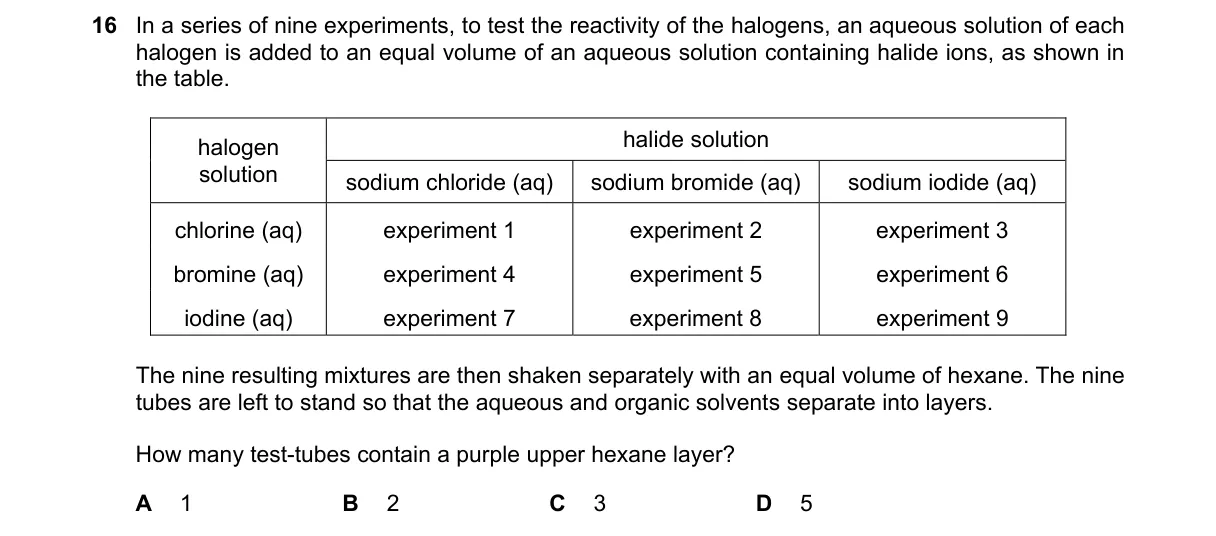
Answer choices
- A1
- B2
- C3
- D5
Explanation
Purple hexane layer from iodine extraction Steps:
- Halogens tested: Cl₂, Br₂, I₂; halides: Cl⁻, Br⁻, I⁻ (9 combinations total).
- Purple color in hexane indicates free I₂, which partitions from aqueous to organic layer.
- I₂ present when added directly: I₂ + Cl⁻, I₂ + Br⁻, I₂ + I⁻ (3 cases).
- I₂ produced by displacement: Cl₂ + I⁻ → I₂ + 2Cl⁻; Br₂ + I⁻ → I₂ + 2Br⁻ (2 cases).
- Total: 5 test tubes with I₂ and purple layer.
Why D is correct:
- Reactivity series (F > Cl > Br > I) predicts I₂ formation in 5 specific combinations, extracting as purple in nonpolar hexane.
Why the others are wrong:
- A: Underestimates by ignoring 4 I₂ cases (3 additions + 1 production).
- B: Underestimates by ignoring 3 I₂ cases.
- C: Underestimates by ignoring 2 I₂ cases.
Final answer: D
Topic: Group 17
Practice more A Levels Chemistry (9701) questions on mMCQ.me