A Levels Chemistry (9701)•9701/13/O/N/20
A Levels Chemistry (9701) — 9701/13/O/N/20, Question 36
Three test-tubes, X, Y and Z, each contain water. • A small amount of NaCl is added to test-tube X. • A small amount of SiCl4 is added to test-tube Y. • A small amount of AlCl3 is added to test-tube Z. After a short time, drops of universal indicator are added to each test-tube. Which statements can be correct?
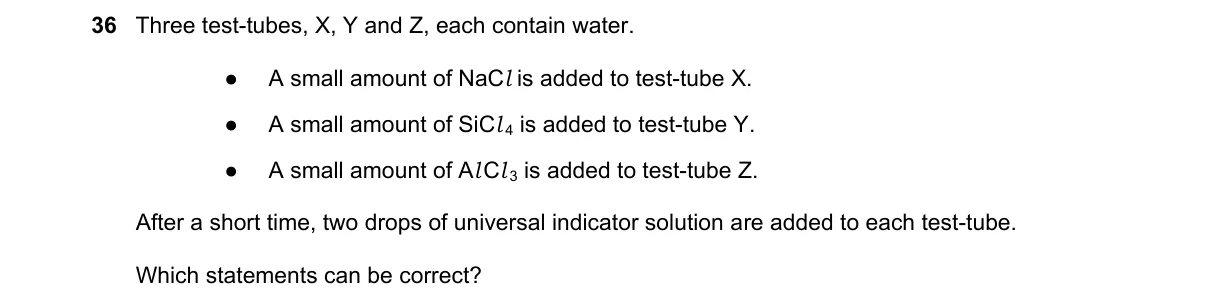
Answer choices
- AOption A
- BOption B
- COption C
- DOption D
Explanation
Hydrolysis behavior of chlorides in water
Steps:
- NaCl dissociates into Na⁺ and Cl⁻ ions, neither hydrolyzes significantly, resulting in neutral pH.
- SiCl₄ reacts with water: SiCl₄ + 4H₂O → Si(OH)₄ + 4HCl, producing H⁺ ions for acidic pH.
- AlCl₃ undergoes hydrolysis: Al³⁺ + 3H₂O ⇌ Al(OH)₃ + 3H⁺, generating H⁺ ions for acidic pH.
- Universal indicator turns green for neutral (X), red for acidic (Y and Z).
Why A is correct:
- A states X neutral and Y/Z acidic, matching the lack of hydrolysis for NaCl versus acid-producing reactions for SiCl₄ and AlCl₃ per hydrolysis definitions.
Why the others are wrong:
- B claims all acidic; incorrect, as NaCl remains neutral without H⁺ production.
- C suggests all neutral; wrong, since SiCl₄ and AlCl₃ hydrolyze to form acids.
- D implies X acidic and Y/Z neutral; false, as only X avoids hydrolysis.
Final answer: A
Topic: The Periodic Table: chemical periodicity
Practice more A Levels Chemistry (9701) questions on mMCQ.me