A Levels Chemistry (9701)•9701/13/O/N/20
A Levels Chemistry (9701) — 9701/13/O/N/20, Question 27
Which pair of test results would prove that a substance, X, is a ketone?
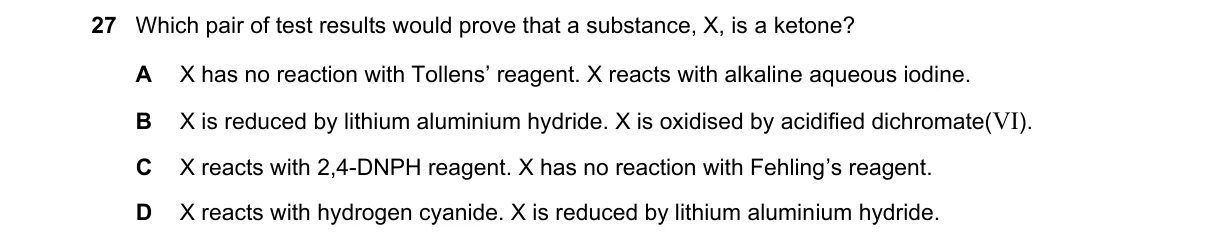
Answer choices
- AX has no reaction with Tollens' reagent. X reacts with alkaline aqueous iodine.
- BX is reduced by lithium aluminium hydride. X is oxidised by acidified dichromate(VI).
- CX reacts with 2,4-DNP reagent. X has no reaction with Fehling's reagent.
- DX reacts with hydrogen cyanide. X is reduced by lithium aluminium hydride.
Explanation
Ketone identification via carbonyl tests
Steps:
- Carbonyl compounds react with 2,4-DNP to form hydrazones, confirming aldehydes or ketones.
- Fehling's reagent oxidizes aldehydes but not ketones, so no reaction indicates no aldehyde.
- Combine these: positive 2,4-DNP and negative Fehling's prove ketone, excluding aldehydes.
- Other tests like Tollens' or iodoform distinguish further but aren't definitive alone.
Why C is correct:
- Ketones form orange 2,4-DNP precipitates (general carbonyl test) but resist Fehling's oxidation due to lacking aldehydic hydrogen (R-CO-R structure).
Why the others are wrong:
- A: No Tollens' rules out aldehydes, but iodoform reaction occurs with methyl ketones and some alcohols/aldehydes, not proving ketone.
- B: LiAlH4 reduces many functional groups (aldehydes, ketones, acids); dichromate oxidizes secondary alcohols to ketones, so ambiguous.
- D: HCN adds to all carbonyls; LiAlH4 reduces aldehydes/ketones/carboxylic acids, so doesn't specify ketone.
Final answer: C
Topic: Carbonyl compounds
Practice more A Levels Chemistry (9701) questions on mMCQ.me