A Levels Chemistry (9701)•9701/13/O/N/20
A Levels Chemistry (9701) — 9701/13/O/N/20, Question 25
One carbon atom in 1-chloro-1-methylcyclohexane is bonded to three other carbon atoms. What is the charge on this carbon atom in 1-chloro-1-methylcyclohexane at Z?
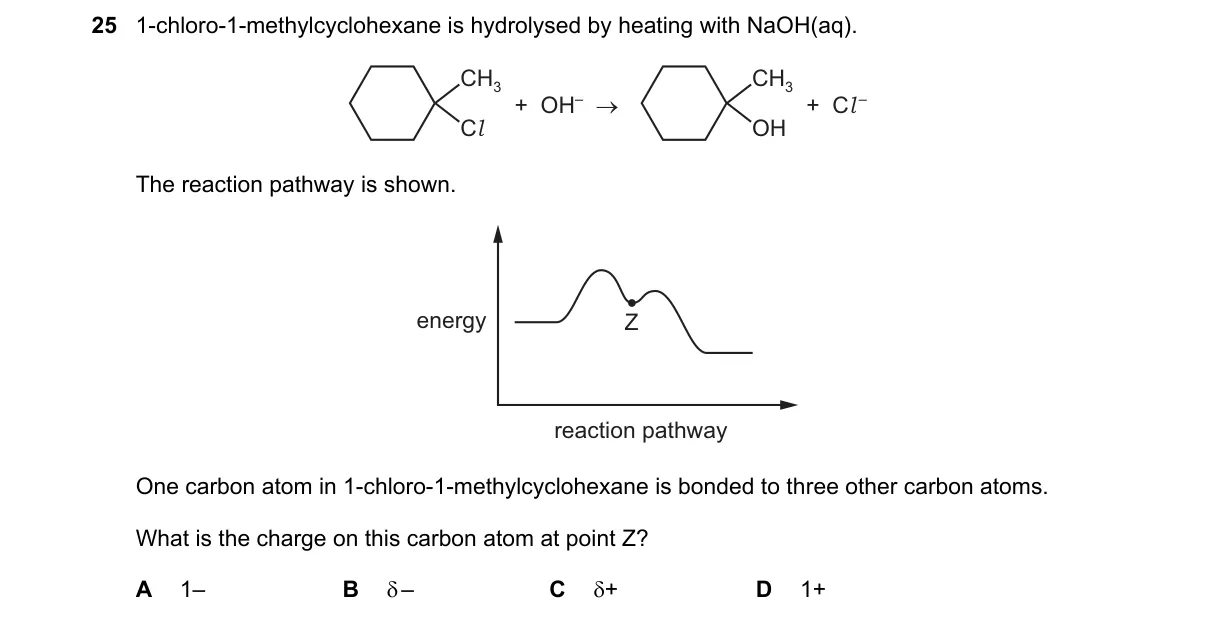
Answer choices
- A1–
- Bδ–
- Cδ+
- D1+
Explanation
Tertiary carbon in alkyl halide forms carbocation Steps:
- Identify the carbon: In 1-chloro-1-methylcyclohexane, the carbon at position 1 bonds to Cl and three carbons (two from ring, one from methyl), making it tertiary.
- Recognize reaction context: At Z, likely the SN1 carbocation intermediate after Cl departure.
- Determine charge: Loss of Cl⁻ leaves the tertiary carbon with a positive charge.
- Confirm: Tertiary carbocations bear a full +1 charge due to electron deficiency.
Why D is correct:
- By definition, a carbocation has a trivalent carbon with a +1 formal charge (6 valence electrons, octet incomplete).
Why the others are wrong:
- A: Full negative charge applies to carbanions, not carbocations.
- B: Partial negative charge occurs on electron-rich atoms, opposite of carbocation.
- C: Partial positive charge describes polar bonds, not full charge in carbocation.
Final answer: D
Topic: Halogen compounds
Practice more A Levels Chemistry (9701) questions on mMCQ.me