A Levels Chemistry (9701)•9701/12/O/N/20
A Levels Chemistry (9701) — 9701/12/O/N/20, Question 24
Ethanol can be converted into ethene in a single reaction. Ethanol can be converted into bromoethane in a single reaction. Under standard laboratory conditions, is a catalyst used in these reactions?
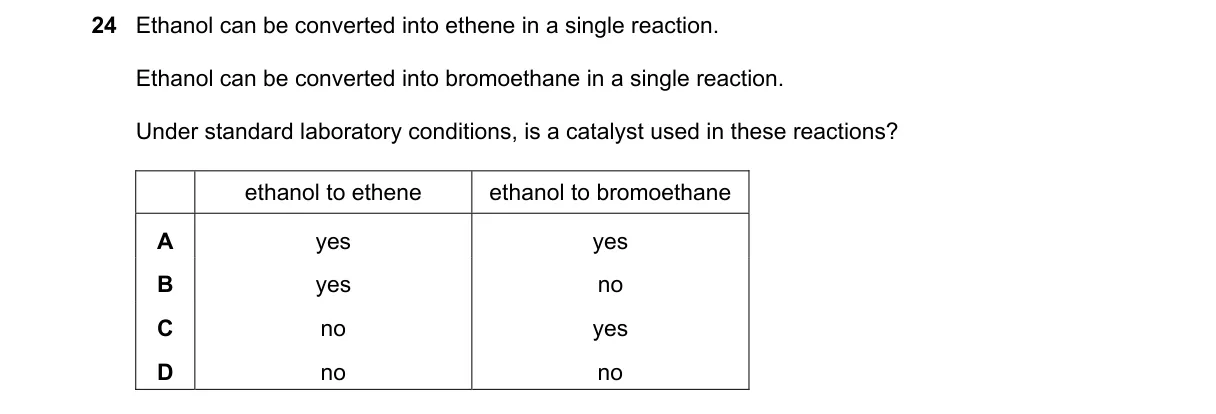
Answer choices
- Ayes (ethanol to ethene), yes (ethanol to bromoethane)
- Byes (ethanol to ethene), no (ethanol to bromoethane)
- Cno (ethanol to ethene), yes (ethanol to bromoethane)
- Dno (ethanol to ethene), no (ethanol to bromoethane)
Explanation
Catalysts in ethanol reactions
Steps:
- Identify ethanol to ethene as acid-catalyzed dehydration: CH3CH2OH → CH2=CH2 + H2O, using concentrated H2SO4 at 170°C.
- Confirm standard lab conditions require H2SO4 as catalyst for dehydration to remove water efficiently.
- Identify ethanol to bromoethane as nucleophilic substitution: CH3CH2OH + HBr → CH3CH2Br + H2O, proceeding without catalyst.
- Verify halogenation uses reagent like HBr directly, no additional catalyst needed under lab conditions.
Why B is correct:
- Dehydration follows the mechanism where H2SO4 acts as a catalyst by protonating the alcohol, facilitating water loss per organic chemistry principles.
Why the others are wrong:
- A: Bromoethane formation uses HBr as reactant, not catalyst.
- C: Ethene requires acid catalyst for dehydration.
- D: Ethene dehydration mandates catalyst use.
Final answer: B
Topic: Hydroxy compounds
Practice more A Levels Chemistry (9701) questions on mMCQ.me