A Levels Chemistry (9701)•9701/12/O/N/20
A Levels Chemistry (9701) — 9701/12/O/N/20, Question 19
Compound X is the oxide of a Period 3 element. Compound X reacts with water to give an acidic solution. A solution is prepared by reacting 0.100 g of compound X with excess of water. This solution is neutralised by exactly 25.0 cm³ of 0.100 mol dm⁻³ sodium hydroxide solution. What would be the identity of compound X?
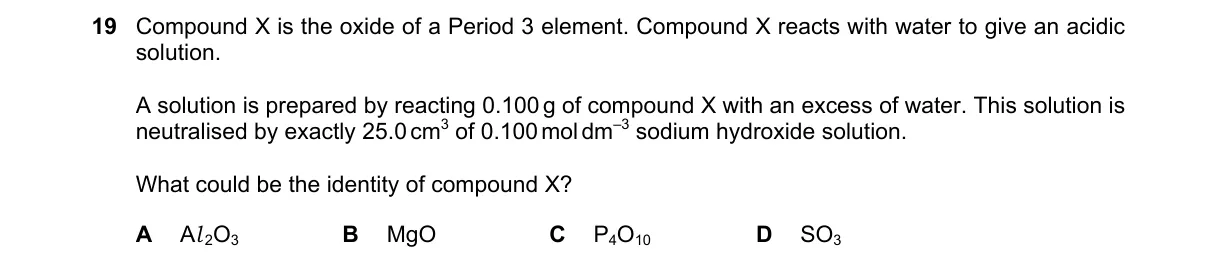
Answer choices
- AAl₂O₃
- BMgO
- CP₄O₁₀
- DSO₂
Explanation
Neutralization data identifies SO₃ by matching molar mass
Steps:
- Moles of NaOH = 0.100 mol dm⁻³ × 0.025 dm³ = 0.00250 mol.
- SO₃ + H₂O → H₂SO₄, where H₂SO₄ + 2 NaOH → Na₂SO₄ + 2 H₂O (2 mol NaOH per mol SO₃).
- Moles of SO₃ = 0.00250 / 2 = 0.00125 mol.
- Molar mass = 0.100 g / 0.00125 mol = 80 g mol⁻¹ (matches SO₃).
Why D is correct:
- SO₃ (oxide of sulfur, Period 3) forms sulfuric acid with water; titration yields exact molar mass of 80 g mol⁻¹ per H₂SO₄'s diprotic nature.
Why the others are wrong:
- A. Al₂O₃: Amphoteric; forms neutral or slightly basic suspension with water, not acidic solution.
- B. MgO: Basic; forms Mg(OH)₂, giving alkaline solution.
- C. P₄O₁₀: Would produce 4 H₃PO₄ (12 mol NaOH per mol P₄O₁₀), requiring only 0.059 g for 0.00250 mol NaOH, not 0.100 g.
Final answer: D
Topic: The Periodic Table: chemical periodicity
Practice more A Levels Chemistry (9701) questions on mMCQ.me