A Levels Chemistry (9701)•9701/12/O/N/20
A Levels Chemistry (9701) — 9701/12/O/N/20, Question 17
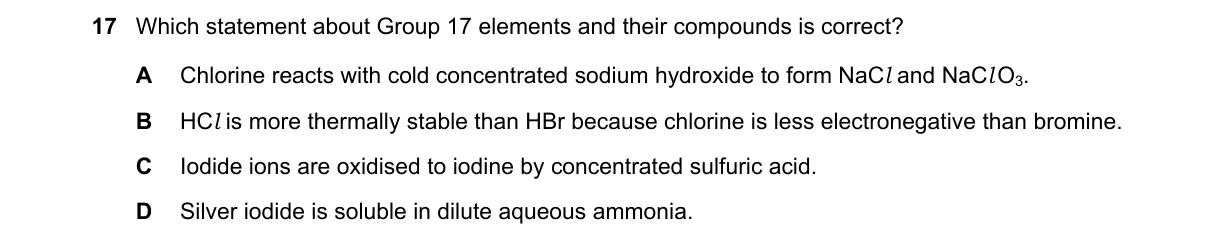
Which statement about Group 17 elements and their compounds is correct?
Answer choices
- AChlorine reacts with cold concentrated sodium hydroxide to form NaCl and NaOCl.
- BHCl is more thermally stable than HBr because chlorine is less electronegative than bromine.
- CIodide ions are oxidised to iodine by concentrated sulphuric acid.
- DSilver iodide is soluble in dilute aqueous ammonia.
Explanation
Oxidation behavior of iodide ions
Steps:
- Recall halogen reactions with NaOH: Cl₂ with cold dilute NaOH forms NaCl + NaClO; cold concentrated forms NaClO₃ with hot conditions.
- Assess HX thermal stability: decreases down group (HCl > HBr) due to weakening H-X bond energies, not electronegativity differences.
- Examine H₂SO₄ with halides: conc. H₂SO₄ oxidizes I⁻ to I₂ (stronger reducing agent than Cl⁻/Br⁻), but dehydrates HCl/HBr.
- Check AgX solubility in NH₃: AgCl dissolves in dilute; AgBr needs concentrated; AgI insoluble.
Why C is correct:
- Concentrated H₂SO₄ acts as an oxidizing agent (E° > I₂/I⁻), oxidizing I⁻ to I₂ via 2I⁻ + H₂SO₄ → I₂ + SO₂ + ... (redox reaction).
Why the others are wrong:
- A: Cl₂ with cold concentrated NaOH forms NaCl + NaClO₃, not NaOCl (requires cold dilute NaOH).
- B: HCl stability > HBr due to stronger H-Cl bond energy; Cl is more electronegative than Br.
- D: AgI insoluble in dilute NH₃ (requires complex formation, ineffective for AgI).
Final answer: C
Topic: Group 17
Practice more A Levels Chemistry (9701) questions on mMCQ.me