A Levels Chemistry (9701)•9701/11/O/N/20
A Levels Chemistry (9701) — 9701/11/O/N/20, Question 21
Two students each make a statement about 2-methylbut-1-ene. Student 1 states that 2-methylbut-1-ene has geometrical isomers. Student 2 states that 2-methylbut-1-ene reacts with HBr in an addition reaction to give 1-bromo-2-methylbutane as the main product. Which students are correct?
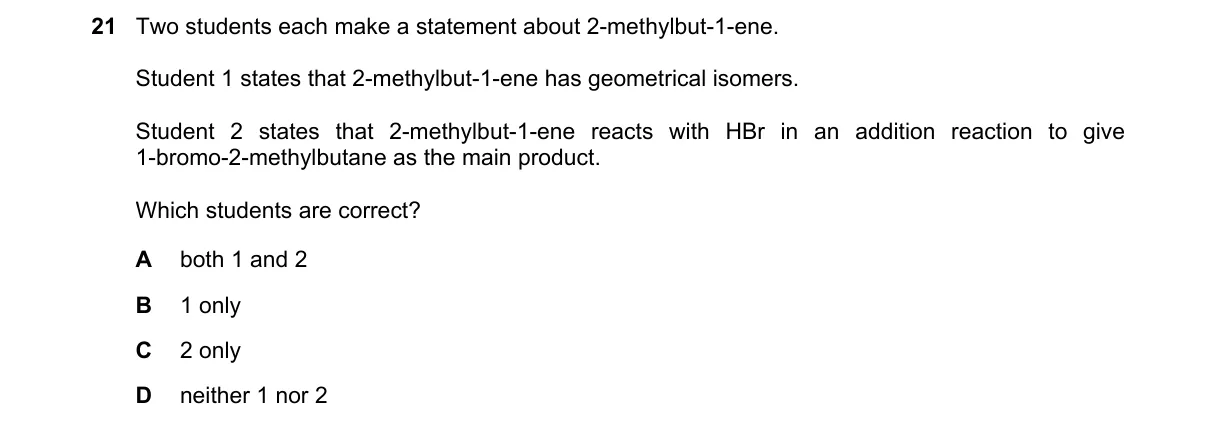
Answer choices
- Aboth 1 and 2
- B1 only
- C2 only
- Dneither 1 nor 2
Explanation
Structure and Reactivity of 2-Methylbut-1-ene
Steps:
- The structure is CH₂=C(CH₃)CH₂CH₃, with the double bond between carbons 1 (CH₂) and 2 (C(CH₃)CH₂CH₃).
- For geometrical isomers, each double-bond carbon needs two different substituents; carbon 1 has two H atoms, preventing cis-trans isomerism.
- HBr addition follows Markovnikov's rule: H adds to carbon 1 (less substituted), forming a tertiary carbocation at carbon 2, so Br adds there, yielding 2-bromo-2-methylbutane (CH₃CBr(CH₃)CH₂CH₃).
- Student 1 is wrong (no geometrical isomers); Student 2 is wrong (main product is 2-bromo-2-methylbutane, not 1-bromo-2-methylbutane).
Why D is correct:
- Neither statement holds: no geometrical isomers due to identical substituents on one alkene carbon, and HBr product follows Markovnikov's rule for the tertiary halide.
Why the others are wrong:
- A: Both students incorrect, as structure lacks geometrical isomerism and addition gives the wrong major product.
- B: Student 1 wrong; terminal =CH₂ prevents geometrical isomers.
- C: Student 2 wrong; Markovnikov addition places Br at the tertiary carbon, not primary.
Final answer: D
Topic: Hydrocarbons
Practice more A Levels Chemistry (9701) questions on mMCQ.me