A Levels Chemistry (9701)•9701/11/O/N/20
A Levels Chemistry (9701) — 9701/11/O/N/20, Question 17
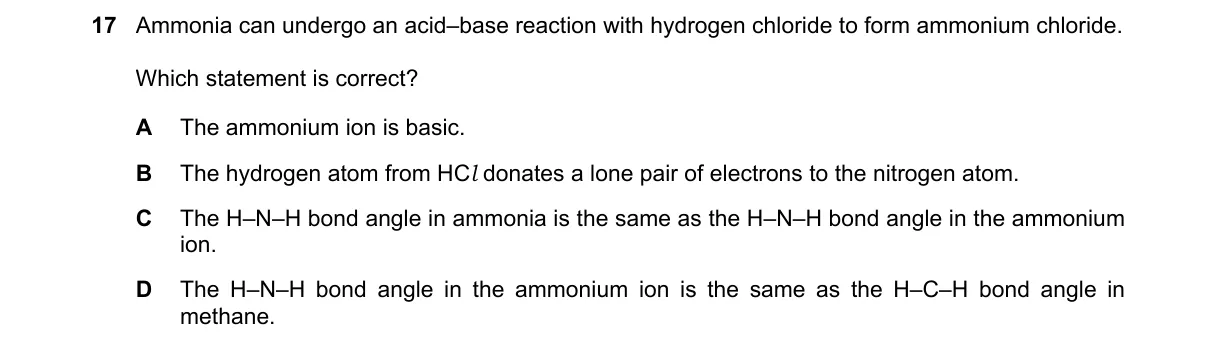
Ammonia can undergo an acid-base reaction with hydrogen chloride to form ammonium chloride. Which statement is correct?
Answer choices
- AThe ammonium ion is basic.
- BThe hydrogen ion from HCl donates a lone pair of electrons to the nitrogen atom.
- CThe H-N-H bond angle in ammonia is the same as the H-N-H bond angle in the ammonium ion
- DThe H-N-H bond angle in ammonium ion is the same as the H-C-H bond angle in methane.
Explanation
Bond Angles in Tetrahedral Molecules
Steps:
- Ammonia (NH3) reacts with HCl to form NH4+, where N accepts H+ using its lone pair.
- NH3 has trigonal pyramidal shape with H-N-H angle ~107° due to lone pair repulsion.
- NH4+ has tetrahedral geometry with four N-H bonds, H-N-H angle 109.5°.
- Methane (CH4) also has tetrahedral geometry with H-C-H angle 109.5°.
Why D is correct:
- Both NH4+ and CH4 follow VSEPR theory for AX4 notation, yielding identical 109.5° bond angles.
Why the others are wrong:
- A: NH4+ is acidic, as it donates H+ (e.g., NH4+ ⇌ NH3 + H+).
- B: N in NH3 donates lone pair to H+ from HCl; H+ does not donate electrons.
- C: NH3 angle is 107° (lone pair distortion); NH4+ is 109.5° (no lone pairs).
Final answer: D
Topic: Nitrogen and sulfur
Practice more A Levels Chemistry (9701) questions on mMCQ.me