A Levels Chemistry (9701)•9701/11/O/N/20
A Levels Chemistry (9701) — 9701/11/O/N/20, Question 15
A student mixes pairs of chemicals together in separate test tubes. • excess calcium(s) + water(l) • calcium carbonate(s) + excess hydrochloric acid(aq) • magnesium sulfate(aq) + barium nitrate(aq) How many of these mixtures produce a white solid?
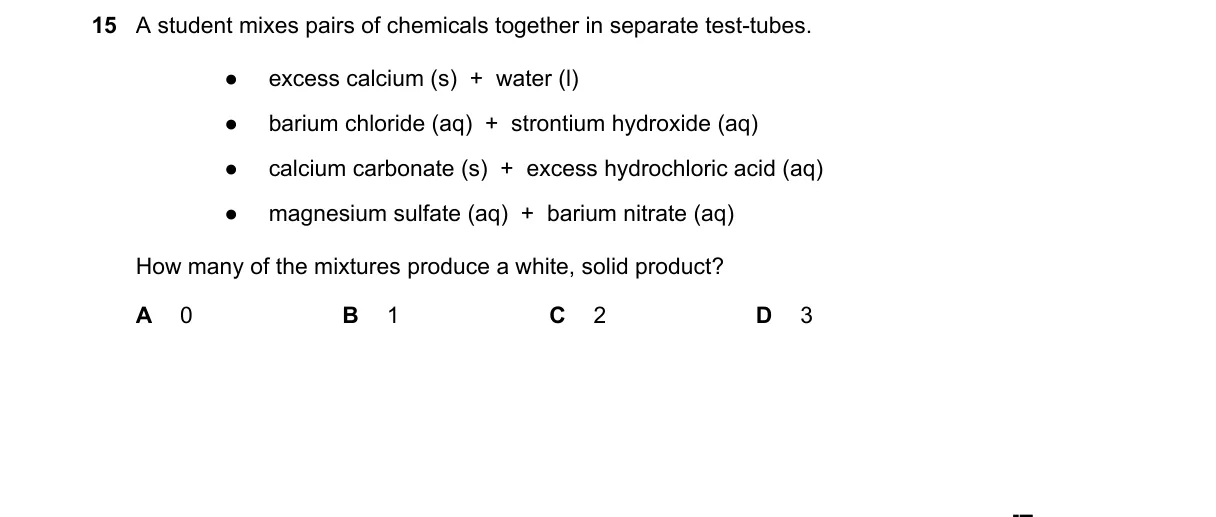
Answer choices
- A0
- B1
- C2
- D3
Explanation
Precipitate Formation in Reactions
Steps:
- First mixture: Calcium reacts with water to form calcium hydroxide (white solid) and hydrogen gas.
- Second mixture: Calcium carbonate dissolves in hydrochloric acid, producing soluble calcium chloride, water, and carbon dioxide gas; no solid forms.
- Third mixture: Magnesium sulfate and barium nitrate undergo double displacement, yielding insoluble barium sulfate (white solid) and soluble magnesium nitrate.
- Total white solids: Two mixtures (first and third).
Why C is correct:
- Exactly two mixtures produce white solids, as Ca(OH)₂ and BaSO₄ are insoluble white precipitates per solubility rules.
Why the others are wrong:
- A: Fails to account for the two white solids formed.
- B: Misses the second white solid (BaSO₄).
- D: Includes the second mixture, which produces no solid.
Final answer: C
Topic: Group 2
Practice more A Levels Chemistry (9701) questions on mMCQ.me