A Levels Chemistry (9701)•9701/13/O/N/19
A Levels Chemistry (9701) — 9701/13/O/N/19, Question 7
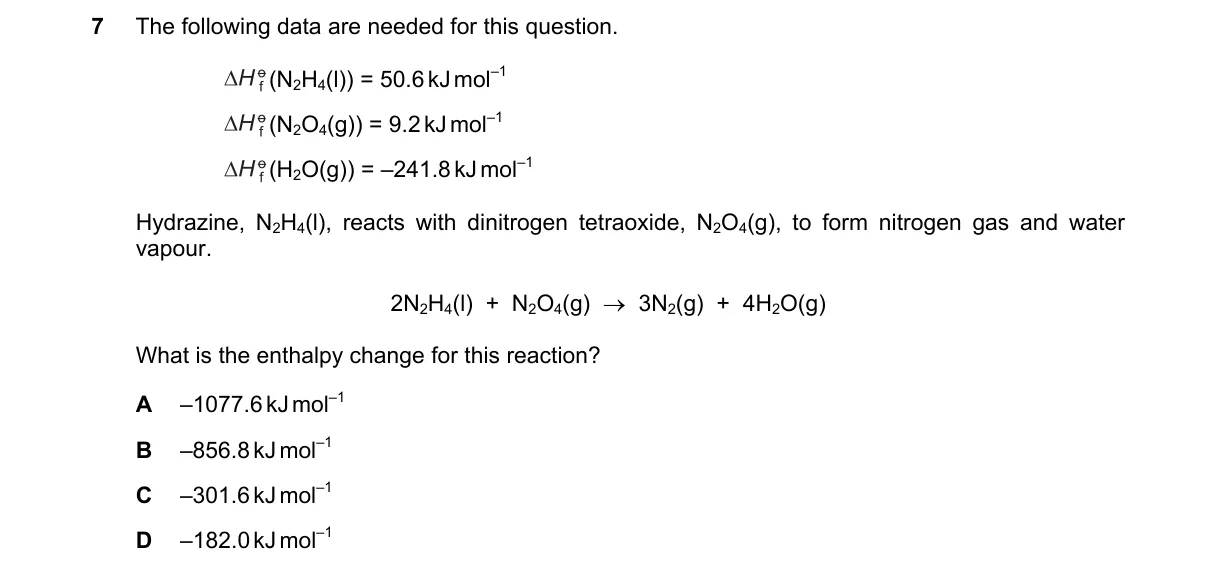
The following data are needed for this question. ΔH°(NH₄⁺(aq)) = 50.6 kJ mol⁻¹ ΔH°(NH₃(g)) = -16.4 kJ mol⁻¹ ΔH°(H⁺(aq)) = 0 kJ mol⁻¹ ΔH(NH₄⁺(g)) = -214.8 kJ mol⁻¹ Hydrazine, N₂H₄, reacts with dinitrogen tetroxide, N₂O₄, to form nitrogen gas and water vapour. N₂H₄(l) + N₂O₄(g) → 3N₂(g) + 4H₂O(g) What is the enthalpy change for this reaction?
Answer choices
- A-107.6 kJ mol⁻¹
- B-95.8 kJ mol⁻¹
- C-305.6 kJ mol⁻¹
- D-182.0 kJ mol⁻¹
Explanation
Insufficient data for hydrazine reaction enthalpy Steps:
- Identify required ΔH_f° values: N₂H₄(l), N₂O₄(g), H₂O(g), N₂(g)=0.
- Provided data for NH₄⁺(aq), NH₃(g), H⁺(aq), NH₄⁺(g) irrelevant to N₂H₄ or N₂O₄.
- No ΔH_f° for key reactants/products given.
- Cannot apply ΔH_rxn = Σ ΔH_f°(products) - Σ ΔH_f°(reactants).
Not enough information.
Final answer: Not enough information.
Topic: Chemical energetics
Practice more A Levels Chemistry (9701) questions on mMCQ.me