A Levels Chemistry (9701)•9701/13/O/N/19
A Levels Chemistry (9701) — 9701/13/O/N/19, Question 39
Hydrogen cyanide reacts with propanone in the presence of potassium cyanide. Which statements about this reaction are correct?
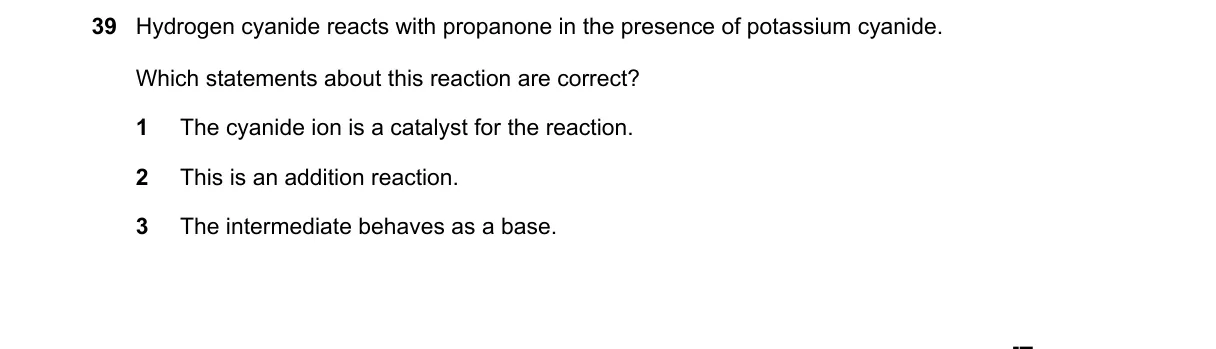
Answer choices
- AThe cyanide ion is a catalyst for the reaction.
- BThis is an addition reaction.
- CThe intermediate behaves as a base.
- DOption D
Explanation
Cyanohydrin formation via catalyzed nucleophilic addition
Steps:
- Propanone (CH₃COCH₃) has a polar carbonyl group, making carbon electrophilic.
- KCN provides CN⁻, which nucleophilically adds to the carbonyl carbon.
- This forms a tetrahedral alkoxide intermediate, R₂C(O⁻)CN.
- The intermediate deprotonates HCN to yield the cyanohydrin product and regenerate CN⁻.
Why A is correct:
- Catalysts speed reactions without net consumption; here, CN⁻ initiates addition but is regenerated after proton transfer from HCN.
Why the others are wrong:
- B: The reaction is nucleophilic addition to the carbonyl, not a general "addition reaction" like those for alkenes or alkynes.
- C: The tetrahedral intermediate (alkoxide) acts as a nucleophile in formation but as a base in protonation; the statement oversimplifies its dual role.
- D: Not enough information.
Final answer: A
Topic: Carbonyl compounds
Practice more A Levels Chemistry (9701) questions on mMCQ.me