A Levels Chemistry (9701)•9701/13/O/N/19
A Levels Chemistry (9701) — 9701/13/O/N/19, Question 34
The stoichiometry of a catalysed reaction is shown below. P(g) + Q(g) → R(g) + S(l). Two experiments are carried out in which the amount of R is measured. The results are shown in the diagram. Which changes in the conditions could explain the results shown?
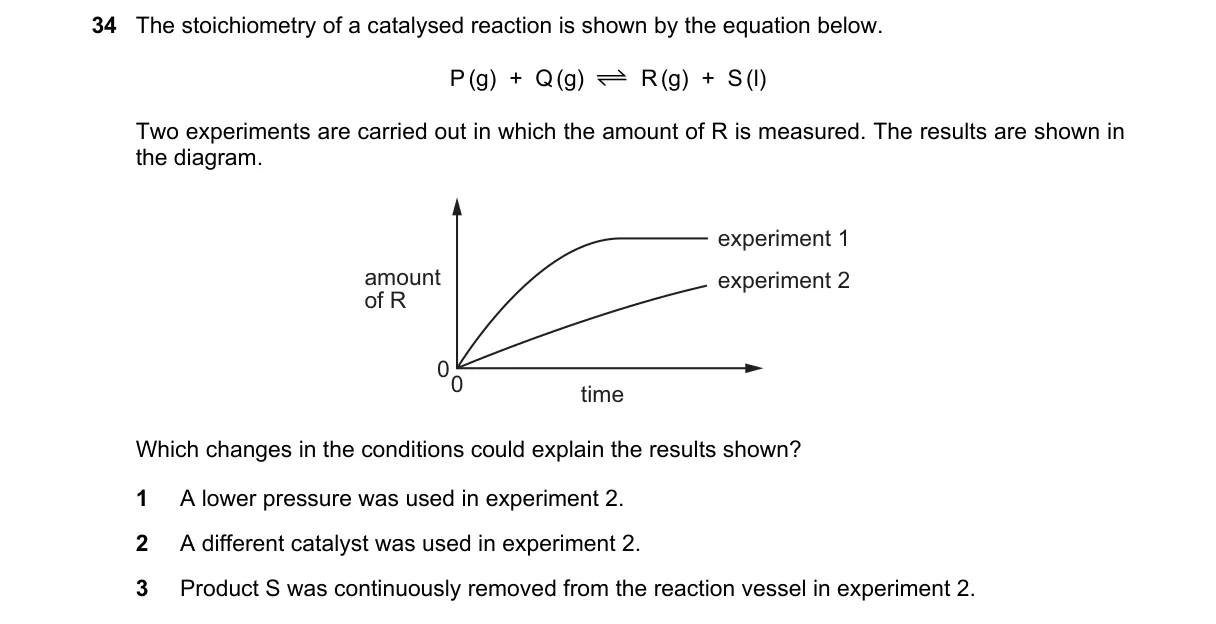
Answer choices
- AA lower pressure was used in experiment 2
- BA different catalyst was used in experiment 2
- CProduct S was continuously removed from the reaction vessel in experiment 2
- DOption D
Explanation
Catalysts alter reaction rates without changing equilibrium position
Steps:
- Identify the reaction as gaseous reactants producing one gas and one liquid product, so rate likely measured by R(g) volume or pressure.
- Assume diagram shows faster R production in experiment 2, indicating higher rate.
- Evaluate options: pressure affects rate via collisions; catalyst changes activation energy; removing S shifts equilibrium by Le Chatelier's principle.
- Select option matching rate change without stoichiometry alteration.
Why B is correct:
- Catalysts lower activation energy, increasing rate constant (k) per Arrhenius equation, explaining faster R formation in experiment 2.
Why the others are wrong:
- A: Lower pressure decreases collision frequency, slowing rate, opposite of faster production.
- C: Removing S shifts equilibrium right, increasing R yield but not necessarily rate.
- D: Insufficient information provided.
Final answer: B
Topic: Equilibria
Practice more A Levels Chemistry (9701) questions on mMCQ.me