A Levels Chemistry (9701)•9701/13/O/N/19
A Levels Chemistry (9701) — 9701/13/O/N/19, Question 28
Tartaric acid, HO2CCH(OH)CH(OH)CO2H, is found in many plants. A sample of tartaric acid with excess LiAlH4 forms the organic product J. What happens when NaBH4(aq) is added to separate samples of tartaric acid and J?
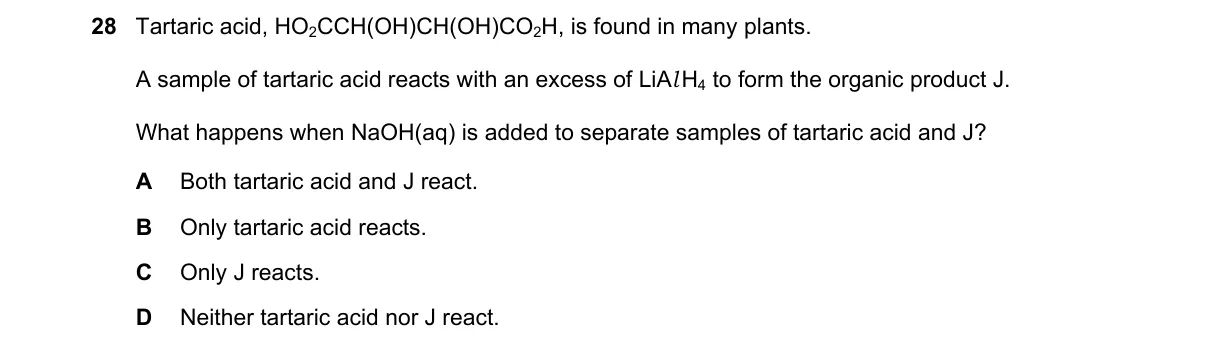
Answer choices
- ABoth tartaric acid and J react.
- BOnly tartaric acid reacts.
- COnly J reacts.
- DNeither tartaric acid nor J reacts.
Explanation
NaBH4 Reactivity with Acids vs. Alcohols
Steps:
- Tartaric acid is HO2CCH(OH)CH(OH)CO2H, a dicarboxylic acid.
- Excess LiAlH4 reduces both COOH groups to CH2OH, forming J as HOCH2CH(OH)CH(OH)CH2OH, a neutral tetraol.
- NaBH4(aq) decomposes with protic acids like COOH, evolving H2 via protonation of BH4-.
- J has only alcohol groups, which are not acidic enough to react with NaBH4.
Why B is correct:
- NaBH4 reacts with carboxylic acids per its known instability toward protic acids, generating H2, but ignores neutral alcohols.
Why the others are wrong:
- A: J lacks acidic protons, so only tartaric acid reacts.
- C: Tartaric acid's COOH groups cause reaction via H2 evolution.
- D: Tartaric acid reacts due to its acidity.
Final answer: B
Topic: Carboxylic acids and derivatives
Practice more A Levels Chemistry (9701) questions on mMCQ.me