A Levels Chemistry (9701)•9701/13/O/N/19
A Levels Chemistry (9701) — 9701/13/O/N/19, Question 24
Bromoethane and chloroethane are added separately to water. Hydrolysis reactions occur. Which compound hydrolyses more rapidly and what is the mechanism?
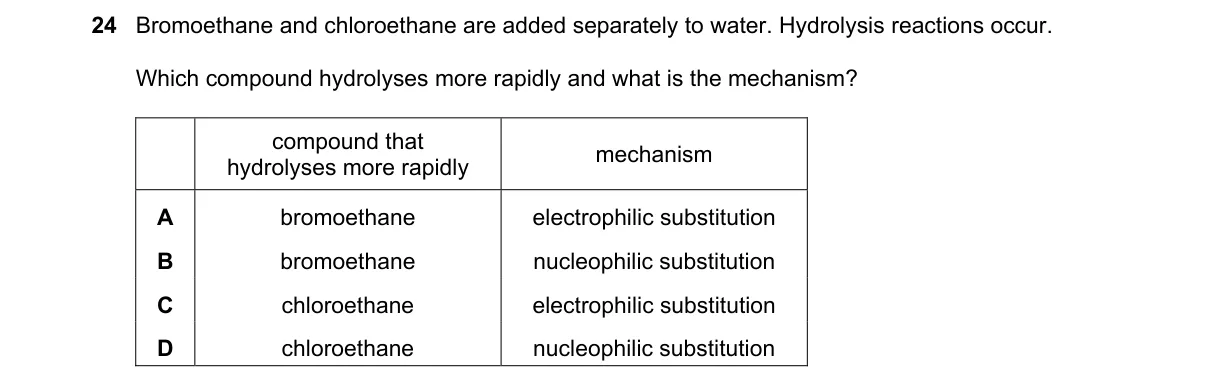
Answer choices
- Abromoethane nucleophilic substitution
- Bchloroethane nucleophilic substitution
- Cbromoethane electrophilic substitution
- Dchloroethane electrophilic substitution
Explanation
Bromoethane hydrolyzes faster via nucleophilic substitution Steps:
- Hydrolysis of haloalkanes involves water acting as a nucleophile attacking the carbon-halogen bond.
- For primary alkyl halides like these, the mechanism is SN2 nucleophilic substitution.
- Leaving group ability determines rate: Br⁻ is a better leaving group than Cl⁻ due to its larger size and weaker C-Br bond.
- Thus, bromoethane reacts more rapidly than chloroethane.
Why A is correct:
- Bromoethane undergoes faster SN2 hydrolysis because Br⁻ is a superior leaving group to Cl⁻, as per leaving group trends in nucleophilic substitution.
Why the others are wrong:
- B: Chloroethane hydrolyzes slower due to poorer leaving group (Cl⁻ vs. Br⁻).
- C: Electrophilic substitution applies to aromatic compounds, not alkyl halide hydrolysis.
- D: Same as C; mechanism is nucleophilic, not electrophilic, and chloroethane is slower.
Final answer: A
Topic: Halogen compounds
Practice more A Levels Chemistry (9701) questions on mMCQ.me