A Levels Chemistry (9701)•9701/13/O/N/19
A Levels Chemistry (9701) — 9701/13/O/N/19, Question 17
Sodium azide, NaN3, is dissolved in water. Acidified silver nitrate is added to the solution and a white precipitate is formed. Aqueous ammonia is then added to the white precipitate. The azide ion, N3-, has similar chemical properties to the Cl- ion. Which row of the table can be predicted from this information for the Cl- ion.
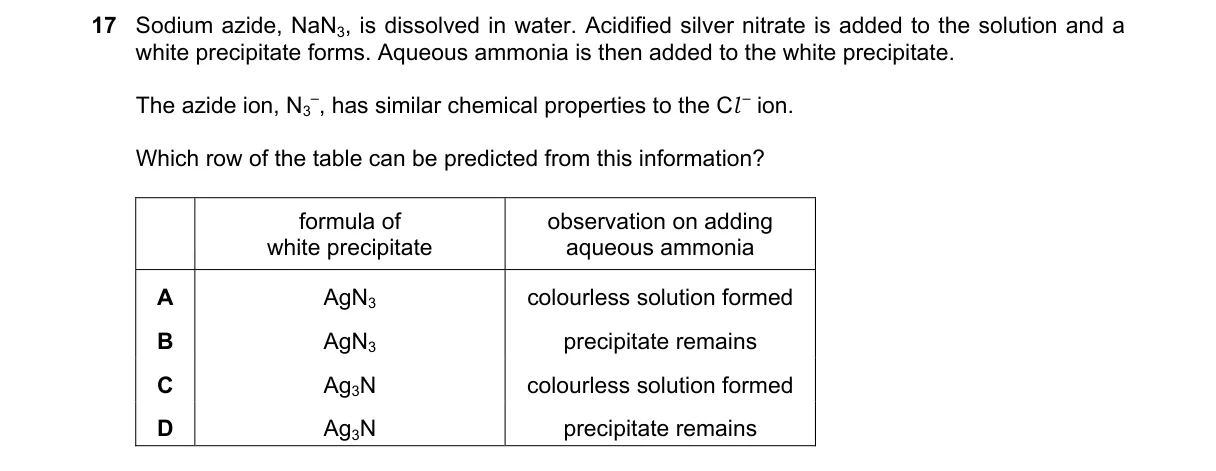
Answer choices
- AAgN3 colourless solution formed
- BAgN3 precipitate remains
- CAgCl colourless solution formed
- DAgCl precipitate remains
Explanation
Similarity between azide and chloride ions in ammonia solubility test
Steps:
- White precipitate forms as AgN3 with acidified AgNO3, mirroring AgCl formation for Cl-.
- Aqueous ammonia addition tests for complex formation and solubility.
- N3- similarity to Cl- implies AgN3 forms soluble [Ag(NH3)2]+ complex like AgCl.
- Thus, colorless solution predicts identical behavior for both precipitates.
Why A is correct:
- Cl- forms colorless [Ag(NH3)2]Cl solution; similarity defines AgN3 yielding colorless solution per coordination chemistry.
Why the others are wrong:
- B: Contradicts solubility; AgN3 dissolves, not remains.
- C: Describes Cl- directly, but prediction uses azide experiment via similarity.
- D: Ignores known AgCl dissolution in dilute ammonia.
Final answer: A
Topic: Group 17
Practice more A Levels Chemistry (9701) questions on mMCQ.me