A Levels Chemistry (9701)•9701/13/O/N/19
A Levels Chemistry (9701) — 9701/13/O/N/19, Question 16
Chlorine and bromine have different volatilities. Which row identifies the more volatile of the two elements, and gives the correct explanation?
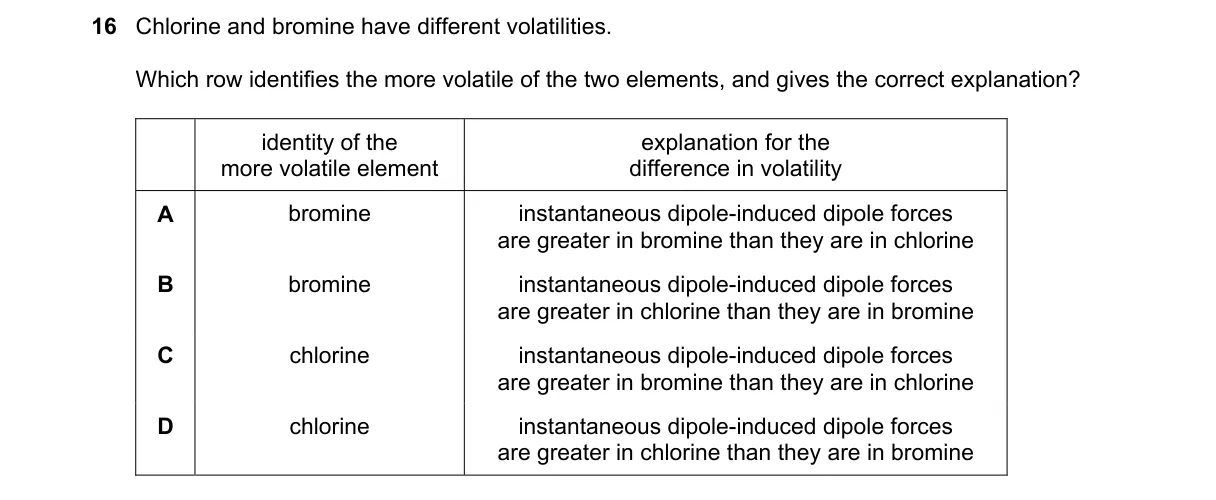
Answer choices
- Abromine instantaneous dipole-induced dipole forces are greater in bromine than they are in chlorine
- Bbromine instantaneous dipole-induced dipole forces are greater in chlorine than they are in bromine
- Cchlorine instantaneous dipole-induced dipole forces are greater in bromine than they are in chlorine
- Dchlorine instantaneous dipole-induced dipole forces are greater in chlorine than they are in bromine
Explanation
Chlorine is more volatile due to weaker London dispersion forces
Steps:
- Chlorine (Cl₂) has a lower boiling point than bromine (Br₂), making it more volatile.
- Both are nonpolar diatomic molecules, so intermolecular forces are instantaneous dipole-induced dipole (London dispersion) forces.
- Dispersion forces increase with molecular size and polarizability; Br₂ is larger than Cl₂, so forces are stronger in Br₂.
- Stronger forces in Br₂ raise its boiling point, confirming Cl₂'s higher volatility.
Why C is correct:
- London dispersion forces are greater in larger Br₂ than in smaller Cl₂, per the trend that polarizability increases down Group 17, leading to weaker forces and higher volatility in Cl₂.
Why the others are wrong:
- A: Incorrectly identifies Br as more volatile and wrongly states forces are greater in Br (should weaken volatility).
- B: Wrongly identifies Br as more volatile and reverses force comparison (forces are not greater in Cl).
- D: Correctly identifies Cl as more volatile but wrongly states forces are greater in Cl (opposite of size trend).
Final answer: C
Topic: Group 17
Practice more A Levels Chemistry (9701) questions on mMCQ.me