A Levels Chemistry (9701)•9701/12/O/N/19
A Levels Chemistry (9701) — 9701/12/O/N/19, Question 6
Which reaction is endothermic?
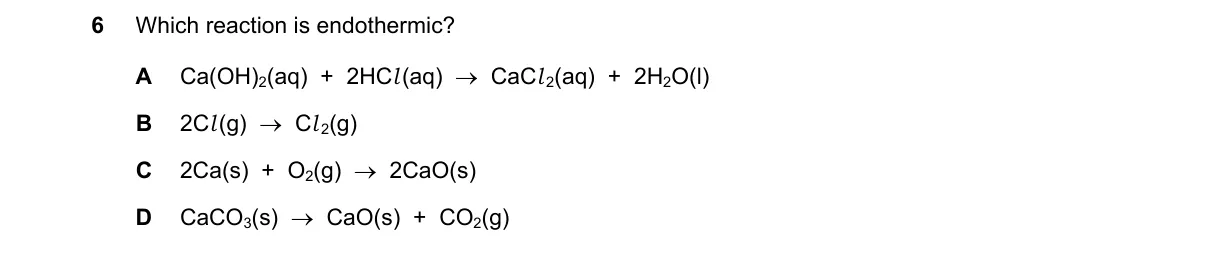
Answer choices
- ACa(OH)₂(aq) + 2HCl(aq) → CaCl₂(aq) + 2H₂O(l)
- B2Cl₂(g) + H₂(g) → 2HCl(g)
- C2Ca(s) + O₂(g) → 2CaO(s)
- DCaCO₃(s) → CaO(s) + CO₂(g)
Explanation
Endothermic reactions absorb heat from surroundings
Steps:
- Recall endothermic reactions have positive ΔH, absorbing energy.
- Note decompositions often require heat input, unlike formations.
- Evaluate options: A and B are neutralizations/formations (exothermic); C is oxidation (exothermic); D is decomposition.
- Confirm D as endothermic via known calcination process.
Why D is correct:
- CaCO₃ decomposition (calcination) requires heat to break bonds, yielding positive ΔH per Hess's law.
Why the others are wrong:
- A: Neutralization of acid-base releases heat (exothermic, ΔH < 0).
- B: HCl synthesis from elements is highly exothermic (ΔH = -184 kJ/mol).
- C: Metal oxide formation liberates energy (exothermic combustion).
Final answer: D
Topic: Chemical energetics
Practice more A Levels Chemistry (9701) questions on mMCQ.me