A Levels Chemistry (9701)•9701/12/O/N/19
A Levels Chemistry (9701) — 9701/12/O/N/19, Question 3
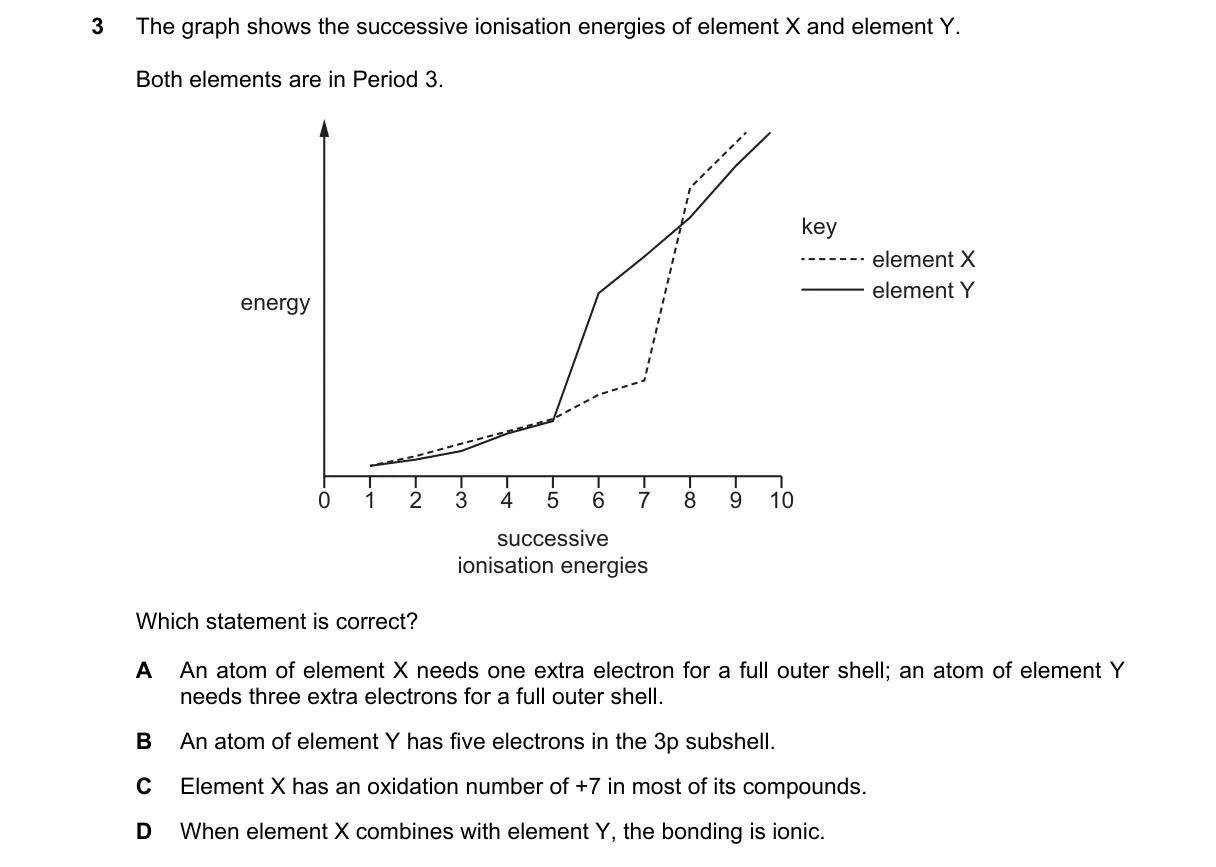
The graph shows the successive ionisation energies of element X and element Y. Both elements are in Period 3. Which statement
Answer choices
- AAn atom of element X loses one extra electron for a fuller outer shell. An atom of element Y needs three extra electrons for a fuller outer shell.
- BElement X has five electrons in the 3p subshell.
- CWhen element X combines with element Y, the bonding is ionic.
- DOption D
Explanation
Valence electrons identified from successive ionization energy jumps
Steps:
- Locate sharp rises in the graph: for X, after the first IE; for Y, after the fifth IE.
- X's pattern (1 low IE then jump) indicates 1 valence electron in 3s subshell (group 1, like Na).
- Y's pattern (5 low IEs then jump) indicates 5 valence electrons in 3s²3p³ (group 15, like P).
- Group 1 loses 1 electron for Ne configuration; group 15 gains 3 electrons for octet.
Why A is correct:
- Ionization energy jumps mark valence electrons removed; X loses 1 for full shell, Y gains 3 (8 total) per octet rule.
Why the others are wrong:
- B: X (group 1) has empty 3p subshell, not five electrons.
- C: Ionization energies suggest polarity but not conclusively ionic bonding without electronegativity data.
- D: Not enough information.
Final answer: A
Topic: Atomic structure
Practice more A Levels Chemistry (9701) questions on mMCQ.me