A Levels Chemistry (9701)•9701/12/O/N/19
A Levels Chemistry (9701) — 9701/12/O/N/19, Question 29
Compound Q can be hydrolysed by HCl(aq). The products of hydrolysis have the same empirical formula as Q. What could Q be?
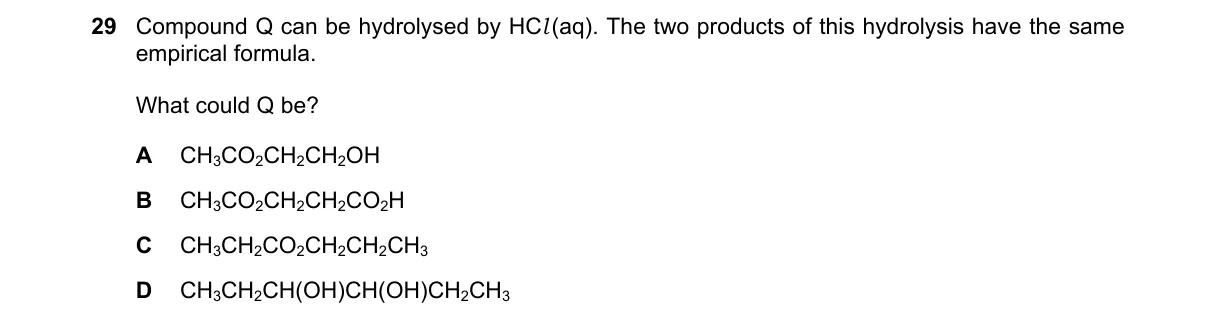
Answer choices
- ACH3COCH3
- BCH3CH2COCH2CH3
- CCH3CH2OCH2CH3
- DCH3CH(OH)CH(OH)CH3
Explanation
Acid-catalyzed ketone isomerization preserves empirical formula Steps:
- Identify compounds that react with HCl(aq): ethers cleave, diols rearrange/dehydrate, ketones enolize/isomerize.
- Check empirical formulas: all differ in products except where isomerization occurs without atom change.
- Test A (acetone, C3H6O): no isomeric ketone possible; no reaction yielding same formula.
- Test B (3-pentanone, C5H10O): isomerizes to 2-pentanone via common enol under acid; same C5H10O. Why B is correct:
- 3-Pentanone shares enol form CH3C(OH)=CHCH2CH3 with 2-pentanone, enabling HCl(aq)-catalyzed tautomerization to isomer with identical molecular/empirical formula C5H10O. Why the others are wrong:
- A: No positional isomer exists for propanone; remains unchanged.
- C: Cleavage gives C2H5Cl + C2H5OH (C4H11OCl total); different empirical.
- D: Rearrangement yields butan-2-one + H2O (C4H8O); loses H2O, changes to C2H4O empirical.
Final answer: B
Topic: Hydroxy compounds
Practice more A Levels Chemistry (9701) questions on mMCQ.me