A Levels Chemistry (9701) — 9701/12/O/N/19, Question 16
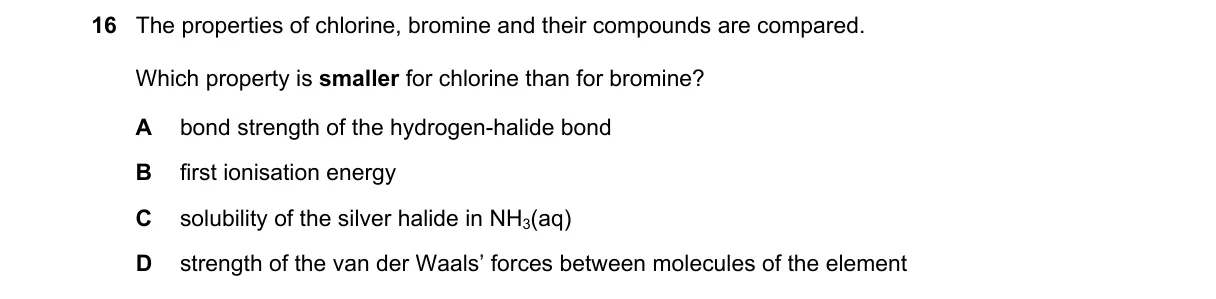
Answer choices
- Abond strength of the hydrogen-halide bond
- Bfirst ionisation energy
- Csolubility of silver halide in NH3(aq)
- Dstrength of the van der Waals' forces between molecules of the element
Explanation
Halogen trends: properties decrease or increase down the group Steps: - Identify periodic trends for halogens: atomic size increases down group 17, affecting bond strengths, energies, and intermolecular forces. - For option A, H-Cl bond energy (431 kJ/mol) exceeds H-Br (366 kJ/mol), so larger for Cl. - For option B, Cl's smaller size yields higher first ionisation energy (1251 kJ/mol) than Br (1140 kJ/mol). - For option C, AgCl solubility in NH3 is higher than AgBr due to stronger complex formation with smaller Cl. - For option D, Cl2 molecules are smaller and less polarizable than Br2, resulting in weaker van der Waals forces. Why D is correct: - Van der Waals forces strengthen with increasing molecular size and electron cloud polarizability, per intermolecular force theory; Cl2 < Br2. Why the others are wrong: - A: H-Cl bond stronger than H-Br due to shorter bond length and higher electronegativity difference. - B: Ionisation energy decreases down group from poorer shielding and larger atomic radius. - C: Smaller halides form more stable ammine complexes, increasing AgCl solubility over AgBr. Final answer: …
Practice more A Levels Chemistry (9701) questions on mMCQ.me