A Levels Chemistry (9701)•9701/12/O/N/19
A Levels Chemistry (9701) — 9701/12/O/N/19, Question 14
When equal volumes of saturated solutions of barium hydroxide and calcium hydroxide are mixed, a white precipitate forms. The mixture is filtered, Y forms while precipitate Z and carbon dioxide is bubbled through the filtrate, producing Y. What are Y and Z?
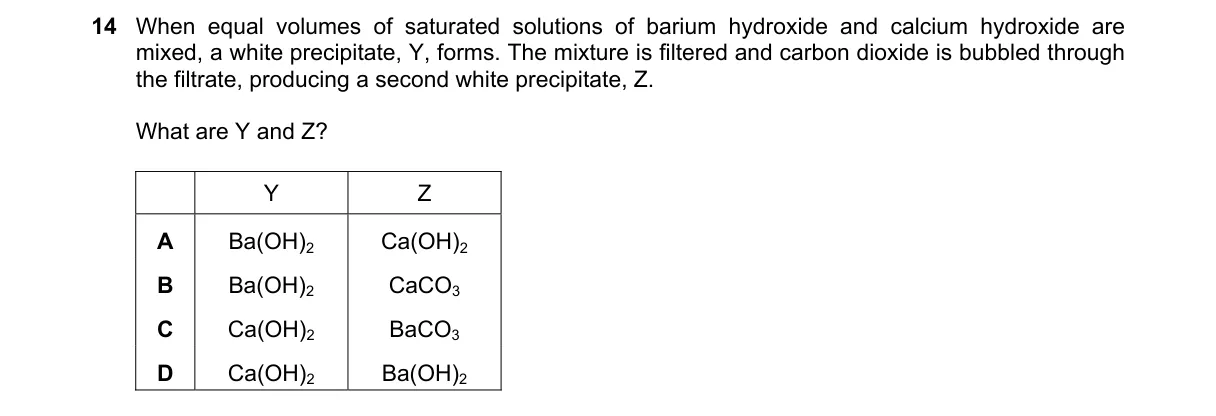
Answer choices
- AY: Ba(OH)_2, Z: Ca(OH)_2
- BY: Ca(OH)_2, Z: BaCO_3
- CY: Ca(OH)_2, Z: BaCO_3
- DY: Ca(OH)_2, Z: Ba(OH)_2
Explanation
Differential solubility causes Ca(OH)₂ precipitation, followed by BaCO₃ formation Steps:
- Mixing equal volumes raises [OH⁻] via soluble Ba(OH)₂, exceeding Ksp for less soluble Ca(OH)₂, forming white precipitate Y = Ca(OH)₂.
- Filtration yields Y as the solid and filtrate rich in Ba²⁺/OH⁻.
- Bubbling CO₂ through filtrate: Ba²⁺ + CO₃²⁻ → BaCO₃ ↓ (white precipitate Z).
- BaCO₃ confirms Z via the reaction Ba(OH)₂ + CO₂ → BaCO₃ + H₂O. Why C is correct:
- Ca(OH)₂ (Ksp = 5.5 × 10⁻⁶) precipitates initially due to common ion effect from Ba(OH)₂ (Ksp = 5 × 10⁻³); CO₂ forms insoluble BaCO₃ (Ksp = 5 × 10⁻⁹). Why the others are wrong:
- A: Ba(OH)₂ is more soluble and stays in solution; initial precipitate is not Ca(OH)₂ as Z.
- B: Identical to C (possible error), but if intending Y = Ba(OH)₂, then Y wrongly assigns soluble species as initial precipitate.
- D: Ba(OH)₂ does not precipitate initially due to higher solubility. Final answer: C
Topic: Group 2
Practice more A Levels Chemistry (9701) questions on mMCQ.me