A Levels Chemistry (9701)•9701/12/O/N/19
A Levels Chemistry (9701) — 9701/12/O/N/19, Question 10
The decomposition of SO2Cl2(g) is a dynamic equilibrium. SO2Cl2(g) ⇌ SO2(g) + Cl2(g) What happens when the pressure of the system is increased?
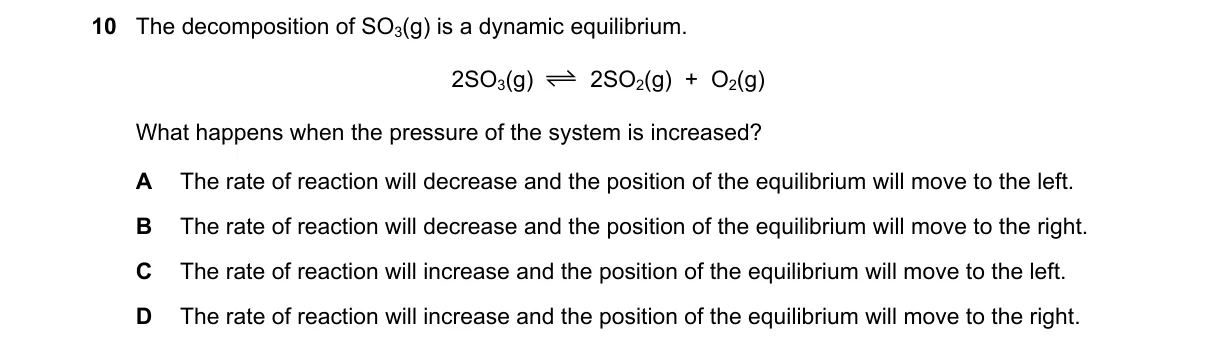
Answer choices
- AThe rate of reaction will decrease and the position of the equilibrium will move to the left.
- BThe rate of reaction will decrease and the position of the equilibrium will move to the right.
- CThe rate of reaction will increase and the position of the equilibrium will move to the left.
- DThe rate of reaction will increase and the position of the equilibrium will move to the right.
Explanation
Le Chatelier's Principle on Pressure in Gaseous Equilibria
Steps:
- Count gas moles: 1 on left (SO2Cl2), 2 on right (SO2 + Cl2).
- Increasing pressure favors fewer moles, shifting equilibrium left to reduce pressure.
- Higher pressure increases molecular collisions, raising both forward and reverse rates.
- Net effect: rates increase, but equilibrium position moves left.
Why C is correct:
- Le Chatelier's principle dictates shift to fewer moles (left) under increased pressure; higher concentrations boost collision frequency, increasing rates per kinetic molecular theory.
Why the others are wrong:
- A: Rates increase, not decrease, with pressure.
- B: Equilibrium shifts left, not right, due to mole difference.
- D: Equilibrium moves left, not right, to oppose pressure increase.
Final answer: C
Topic: Equilibria
Practice more A Levels Chemistry (9701) questions on mMCQ.me