A Levels Chemistry (9701)•9701/11/O/N/19
A Levels Chemistry (9701) — 9701/11/O/N/19, Question 5
Ethanol, CH3CH2OH, ethanol, CH3OH, and methoxymethane, CH3OCH3, are three organic compounds. Which compound has the highest boiling point and what is the interaction that causes this boiling point to be the highest?
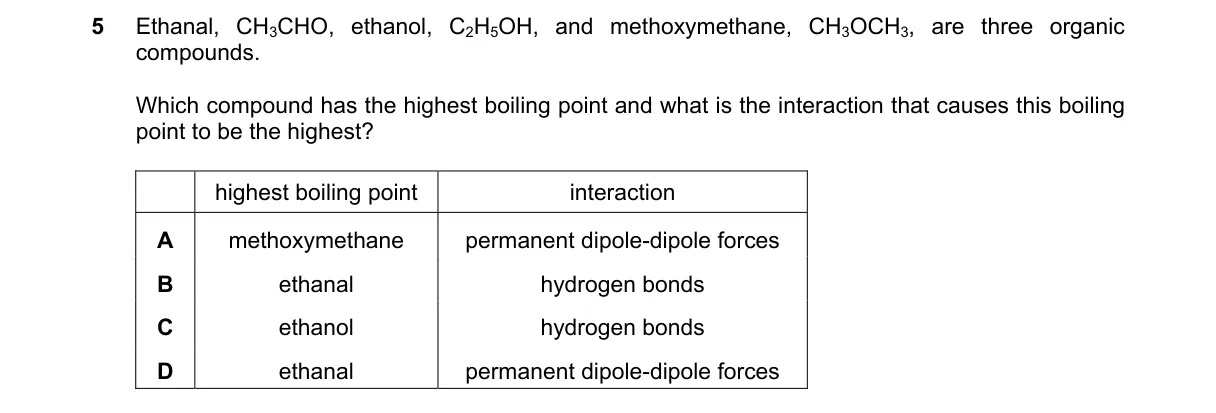
Answer choices
- Amethoxymethane permanent dipole-dipole forces
- Bethanol hydrogen bonds
- Cethanol hydrogen bonds
- Dethanol permanent dipole-dipole forces
Explanation
Hydrogen bonding in ethanol yields the highest boiling point
Steps:
- Identify functional groups: Ethanol (CH3CH2OH) and methanol (CH3OH) contain -OH groups enabling hydrogen bonding; methoxymethane (CH3OCH3) is an ether with only dipole-dipole forces.
- Compare forces: Hydrogen bonds are stronger than permanent dipole-dipole forces, so methoxymethane has the lowest boiling point.
- Compare alcohols: Both form hydrogen bonds, but ethanol's larger molecular weight (46 g/mol vs. methanol's 32 g/mol) increases London dispersion forces, raising its boiling point above methanol's.
- Confirm values: Ethanol boils at 78°C, methanol at 65°C, methoxymethane at -24°C.
Why C is correct:
- Ethanol exhibits hydrogen bonding (O-H···O), the strongest intermolecular force here, combined with its size for the highest boiling point.
Why the others are wrong:
- A: Methoxymethane lacks hydrogen bonding, relying on weaker dipole-dipole forces for its low boiling point.
- B: Methanol forms hydrogen bonds but has lower molecular weight, resulting in a boiling point below ethanol's.
- D: Ethanol's dominant force is hydrogen bonding, not just permanent dipole-dipole forces.
Final answer: C
Topic: Hydroxy compounds
Practice more A Levels Chemistry (9701) questions on mMCQ.me