A Levels Chemistry (9701)•9701/11/O/N/19
A Levels Chemistry (9701) — 9701/11/O/N/19, Question 36
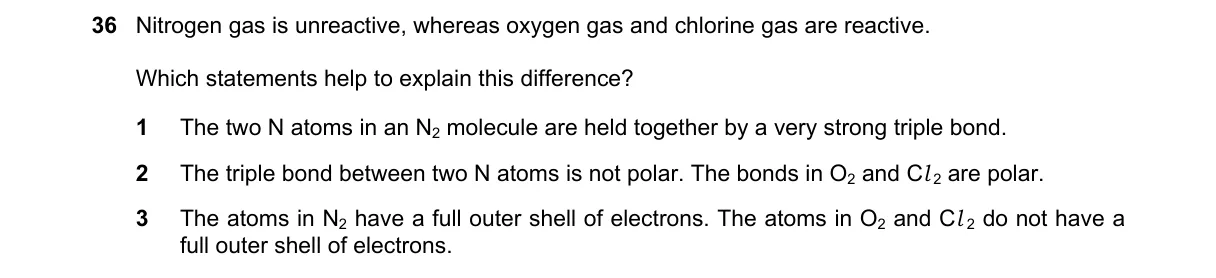
Nitrogen gas is unreactive, whereas oxygen gas and chlorine gas are reactive. Which statements help to explain this difference?
Answer choices
- AThe two N atoms in a N2 molecule are held together by a very strong triple bond.
- BThe triple bond in N2 is nonpolar. The bonds in O2 and Cl2 are polar.
- CThe atoms in N2 have a full outer shell of electrons. The atoms in O2 and Cl2 do not have a full outer shell of electrons.
- DOption D
Explanation
Bond strength determines reactivity of diatomic gases Steps:
- Identify bond types: N2 has a triple bond (945 kJ/mol), O2 a double bond (498 kJ/mol), Cl2 a single bond (243 kJ/mol).
- Compare bond energies: Higher energy in N2 requires more activation to break, reducing reactivity.
- Evaluate electron configurations: All molecules achieve octet rule via bonding, so stability isn't due to incomplete shells.
- Assess polarity: All homonuclear diatomic bonds are nonpolar, so polarity doesn't explain differences.
Why D is correct:
- D selects statements accurately explaining N2's high bond dissociation energy as the primary factor limiting reactivity, per bond energy principles.
Why the others are wrong:
- A: True but incomplete; doesn't address why O2/Cl2 react easier despite their bonds.
- B: False; O2 and Cl2 bonds are nonpolar like N2, as atoms are identical.
- C: False; all atoms in N2, O2, Cl2 achieve full octets through covalent bonding.
Final answer: D
Topic: Chemical bonding
Practice more A Levels Chemistry (9701) questions on mMCQ.me