A Levels Chemistry (9701)•9701/11/O/N/19
A Levels Chemistry (9701) — 9701/11/O/N/19, Question 33
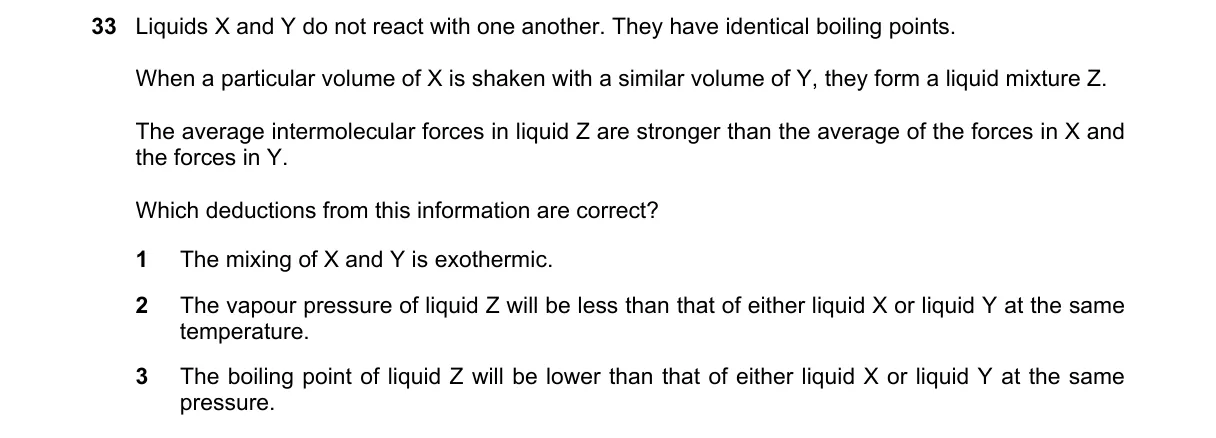
Liquids X and Y do not react with one another. They have identical boiling points. When a partial volume of X is shaken with a similar volume of Y, they form a mixture. The average intermolecular forces in liquid Z are stronger than the average of the forces in X and the forces in Y. Which of the following deductions from this information are correct?
Answer choices
- AThe mixing of X and Y is exothermic.
- BThe vapour pressure of liquid Z will be less than that of either liquid X or liquid Y at the same temperature.
- CThe boiling point of liquid Z will be lower than that of either liquid X or liquid Y at the same pressure.
- DOption D
Explanation
Intermolecular forces determine vapor pressure and boiling point of the mixture Z
Steps:
- X and Y have identical boiling points, so they have comparable intermolecular forces and vapor pressures.
- Mixing forms Z, where average intermolecular forces exceed the average of those in X and Y.
- Stronger forces in Z reduce molecular escape rate, lowering vapor pressure at a given temperature.
- Lower vapor pressure of Z implies higher boiling point than X or Y at the same pressure.
Why B is correct:
- Stronger intermolecular forces decrease vapor pressure, as fewer molecules overcome attractions to enter the vapor phase (Clausius-Clapeyron relation).
Why the others are wrong:
- A: Not enough information; stronger forces in Z suggest possible exothermic mixing but do not confirm enthalpy change without interaction details.
- C: Stronger forces increase boiling point, opposite of the deduction.
Final answer: B
Topic: States of matter
Practice more A Levels Chemistry (9701) questions on mMCQ.me