A Levels Chemistry (9701)•9701/11/O/N/19
A Levels Chemistry (9701) — 9701/11/O/N/19, Question 28
Tartaric acid, HO2CCH(OH)CH(OH)CO2H, is found in many plants. A sample of tartaric acid with excess LiAlH4 forms the organic product J. What happens when NaBH4(aq) is added to separate samples of tartaric acid and J?
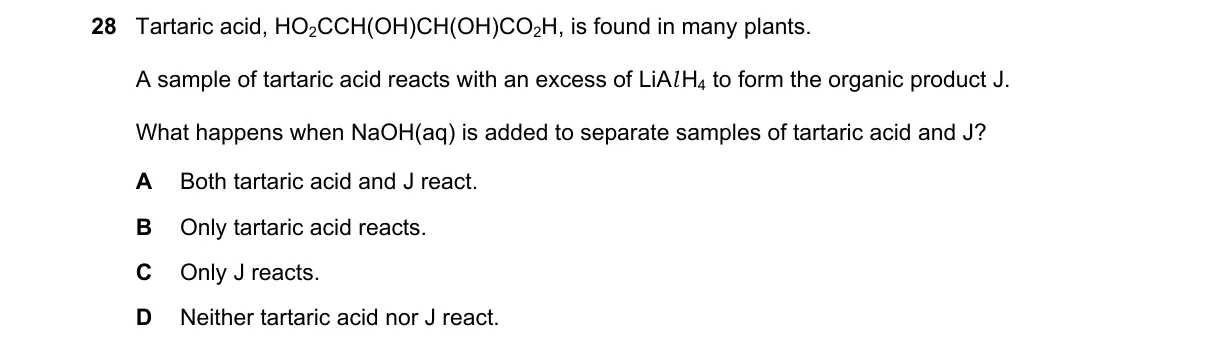
Answer choices
- ABoth tartaric acid and J react.
- BOnly tartaric acid reacts.
- COnly J reacts.
- DNeither tartaric acid nor J reacts.
Explanation
NaBH4 reacts with carboxylic acids via H2 evolution but not with alcohols
Steps:
- Tartaric acid is HO2CCH(OH)CH(OH)CO2H, a dicarboxylic acid.
- Excess LiAlH4 reduces both COOH groups to CH2OH, forming J as HOCH2CH(OH)CH(OH)CH2OH (a tetraol).
- NaBH4(aq) with tartaric acid: acidic COOH protons decompose NaBH4, evolving H2 gas (reaction occurs).
- NaBH4(aq) with J: neutral alcohol groups do not decompose NaBH4 (no reaction).
Why B is correct:
- Tartaric acid's COOH groups protonate BH4-, causing decomposition and H2 evolution, per NaBH4's sensitivity to strong acids.
Why the others are wrong:
- A: J lacks COOH, so no reaction with NaBH4.
- C: Tartaric acid reacts due to acidity, unlike J.
- D: Tartaric acid does react, producing H2.
Final answer: B
Topic: Carboxylic acids and derivatives
Practice more A Levels Chemistry (9701) questions on mMCQ.me