A Levels Chemistry (9701)•9701/11/O/N/19
A Levels Chemistry (9701) — 9701/11/O/N/19, Question 17
Sodium azide, NaN3, is dissolved in water, acidified silver nitrate is added to the solution and aqueous ammonia is then added to the white precipitate. The azide ion, N3-, has similar chemical properties to the Cl- ion. Which row of the table can be predicted from this information.
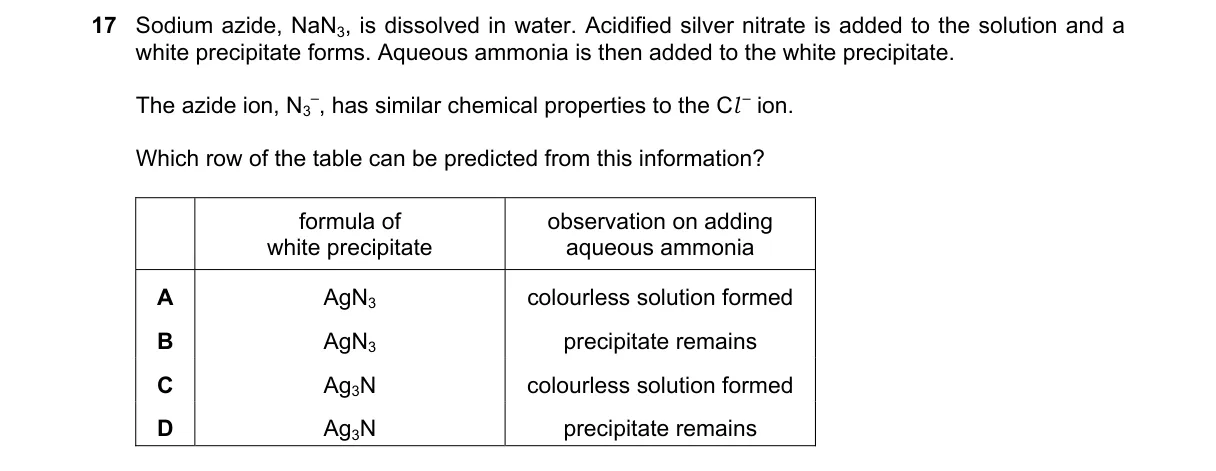
Answer choices
- Awhite precipitate aqueous solution formed
- BAgN colourless solution formed
- CAgN precipitate remains
- DAgN precipitate remains
Explanation
Azide ion behaves like chloride in the silver nitrate test
Steps:
- Dissolve NaN3 in water to get N3- ions.
- Acidify to ensure complete ionization; add AgNO3 to form white AgN3 precipitate (similar to AgCl).
- Add aqueous ammonia, which complexes with Ag+ as [Ag(NH3)2]+, dissolving the precipitate.
- Predict outcome based on N3- similarity to Cl-, where AgCl dissolves in dilute NH3.
Why A is correct:
- AgN3, like AgCl, is soluble in aqueous ammonia due to formation of the diamminesilver(I) complex, [Ag(NH3)2]+(aq).
Why the others are wrong:
- B: No AgN compound forms; precipitate is AgN3, and solution isn't specified as colourless.
- C: Precipitate dissolves, doesn't remain, unlike AgBr.
- D: Same as C; precipitate dissolves in ammonia.
Final answer: A
Topic: Analytical techniques
Practice more A Levels Chemistry (9701) questions on mMCQ.me