A Levels Chemistry (9701)•9701/13/O/N/18
A Levels Chemistry (9701) — 9701/13/O/N/18, Question 17
Reaction 1: Chlorine reacts with cold aqueous sodium hydroxide to form Z. Reaction 2: Z is heated and forms ClO⁻(aq) and Cl⁻(aq).
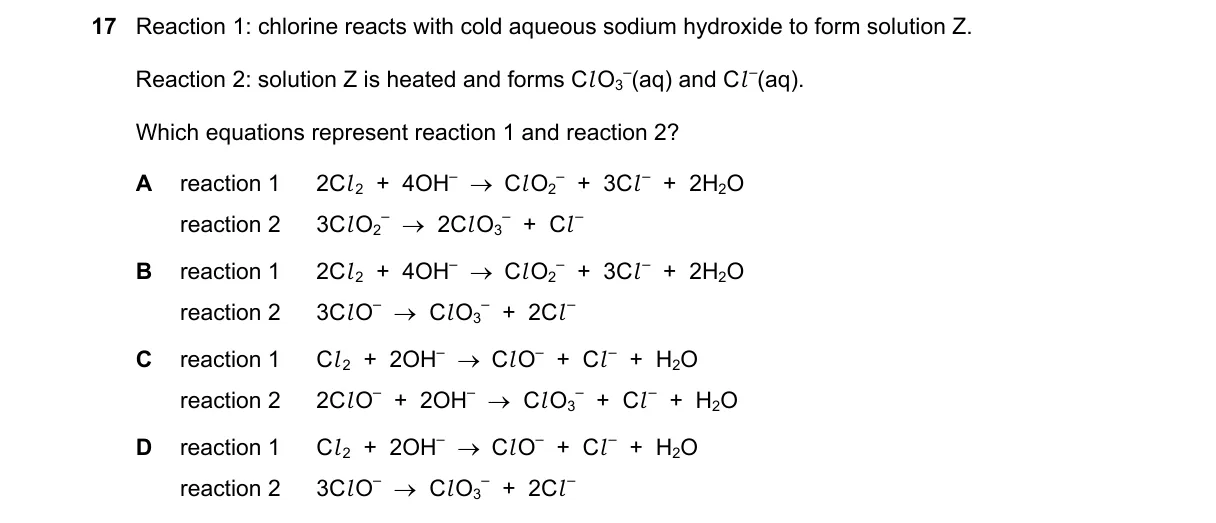
Answer choices
- Areaction 1 2Cl₂ + 4OH⁻ → ClO⁻ + 3Cl⁻ + 2H₂O reaction 2 3ClO⁻ → 2ClO₃⁻ + Cl⁻
- Breaction 1 3Cl₂ + 3OH⁻ → ClO⁻ + 5Cl⁻ + 3H₂O reaction 2 ClO⁻ → ClO₃⁻ + Cl⁻
- Creaction 1 Cl₂ + 2OH⁻ → ClO⁻ + Cl⁻ + H₂O reaction 2 ClO⁻ + 2OH⁻ → ClO₃⁻ + Cl⁻ + H₂O
- Dreaction 1 Cl₂ + 2OH⁻ → ClO⁻ + Cl⁻ + H₂O reaction 2 3ClO⁻ → ClO₃⁻ + 2Cl⁻
Explanation
Chlorine disproportionation in alkaline medium
Steps:
- Reaction 1 with cold NaOH forms hypochlorite (ClO⁻) via Cl₂ + 2OH⁻ → ClO⁻ + Cl⁻ + H₂O, so Z is ClO⁻.
- Heating Z (ClO⁻) causes disproportionation to chlorate (ClO₃⁻) and chloride: 3ClO⁻ → ClO₃⁻ + 2Cl⁻.
- Match reaction 1 to options: only C and D have correct Cl₂ + 2OH⁻ → ClO⁻ + Cl⁻ + H₂O.
- Match reaction 2: only D has the standard 3ClO⁻ → ClO₃⁻ + 2Cl⁻ (no OH⁻ involved).
Why D is correct:
- Matches the established disproportionation formula for hot concentrated NaOH conditions, where hypochlorite converts to chlorate and chloride without additional OH⁻.
Why the others are wrong:
- A: Reaction 1 has incorrect 2Cl₂ stoichiometry for cold dilute conditions.
- B: Reaction 1 uses wrong 3Cl₂ + 3OH⁻, not standard for cold NaOH.
- C: Reaction 2 incorrectly adds 2OH⁻, resembling cold reaction instead of heating.
Final answer: D
Topic: Group 17
Practice more A Levels Chemistry (9701) questions on mMCQ.me