A Levels Chemistry (9701)•9701/13/O/N/18
A Levels Chemistry (9701) — 9701/13/O/N/18, Question 11
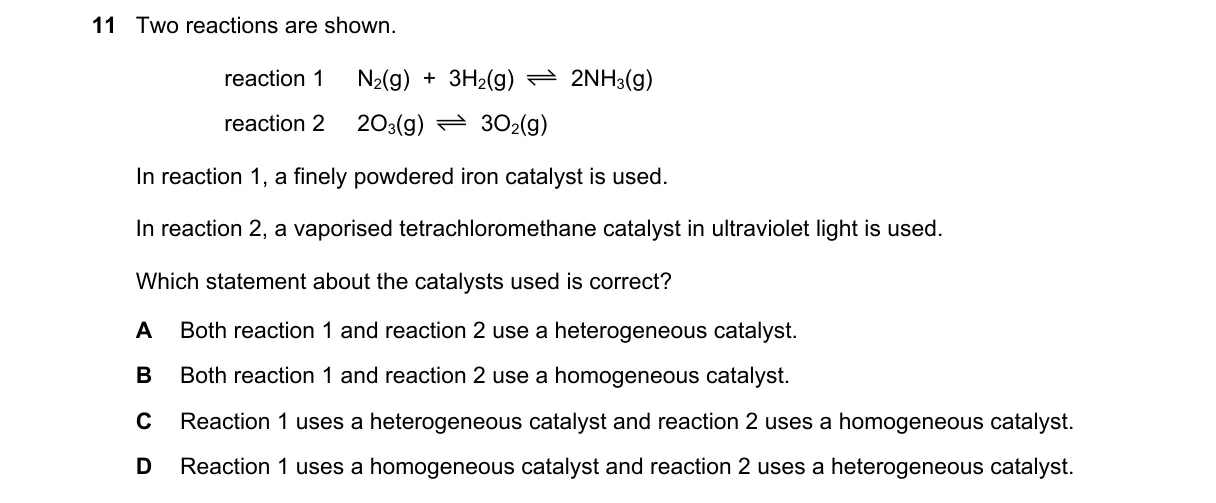
Two reactions are shown. Reaction 1: N2(g) + 3H2(g) → 2NH3(g) In reaction 1, a finely divided Fe(s) is used. In reaction 2, a vaporized tetrachloroethane catalyst is used in ultraviolet light. Which statement about the catalysts used is correct?
Answer choices
- ABoth reaction 1 and reaction 2 use a heterogeneous catalyst.
- BBoth reaction 1 and reaction 2 use a homogeneous catalyst.
- CReaction 1 uses a heterogeneous catalyst and reaction 2 uses a homogeneous catalyst.
- DReaction 1 uses a homogeneous catalyst and reaction 2 uses a heterogeneous catalyst.
Explanation
Catalysts classified by phase relative to reactants
Steps:
- Reaction 1 involves gaseous reactants (N2, H2) and solid Fe catalyst, differing in phase.
- This makes reaction 1's catalyst heterogeneous, as it is in a different phase from reactants.
- Reaction 2 uses vaporized (gaseous) tetrachloroethane catalyst under UV light, implying gaseous reactants for photochemical process.
- Thus, reaction 2's catalyst is homogeneous, same phase as reactants.
Why C is correct:
- Heterogeneous catalysts are in a different phase (solid Fe vs. gases); homogeneous are in the same phase (gaseous catalyst vs. likely gaseous reactants), per standard catalyst definitions.
Why the others are wrong:
- A: Reaction 2 uses homogeneous catalyst, not heterogeneous.
- B: Reaction 1 uses heterogeneous catalyst, not homogeneous.
- D: Reverses the catalyst types for each reaction.
Final answer: C
Topic: Reaction kinetics
Practice more A Levels Chemistry (9701) questions on mMCQ.me