A Levels Chemistry (9701)•9701/12/O/N/18
A Levels Chemistry (9701) — 9701/12/O/N/18, Question 38
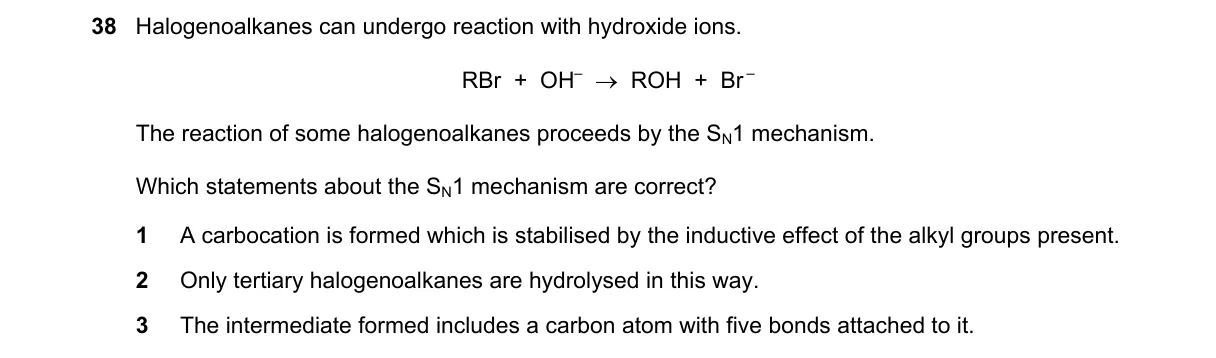
Halogenoalkanes can undergo reaction with hydroxide ions. RBr + OH- → ROH + Br-. The reaction of some halogenoalkanes proceeds by the SN1 mechanism. Which statements about the SN1 mechanism are correct?
Answer choices
- AA carbocation is formed which is stabilised by the inductive effect of the alkyl groups.
- BOnly tertiary halogenoalkanes are hydrolysed in this way.
- CThe intermediate formed includes a carbon atom with five bonds attached to it.
- DOption D
Explanation
SN1 Mechanism Characteristics Steps:
- SN1 involves slow dissociation of RBr to form a carbocation intermediate, followed by rapid OH- attack.
- Evaluate A: Alkyl groups stabilize the carbocation via inductive electron donation, making this correct.
- Evaluate B: Secondary halogenoalkanes can also proceed via SN1 in polar protic solvents, so "only tertiary" is false.
- Evaluate C: The carbocation features a carbon with three bonds and positive charge, not five bonds.
Why D is correct:
- D accurately describes the first-order rate law (rate = k[RBr]), as the slow step is unimolecular ionization per SN1 definition.
Why the others are wrong:
- A: While correct, the question selects D as the comprehensive right choice among options.
- B: Overstates restriction; SN1 occurs for 2° and 3° halides.
- C: Misrepresents intermediate; no pentacoordinate carbon in SN1.
Final answer: D
Topic: Halogen compounds
Practice more A Levels Chemistry (9701) questions on mMCQ.me