A Levels Chemistry (9701)•9701/12/O/N/18
A Levels Chemistry (9701) — 9701/12/O/N/18, Question 3
Rubidium and bromine form ions that are isoelectronic. Each ion has 36 electrons. Which row is correct?
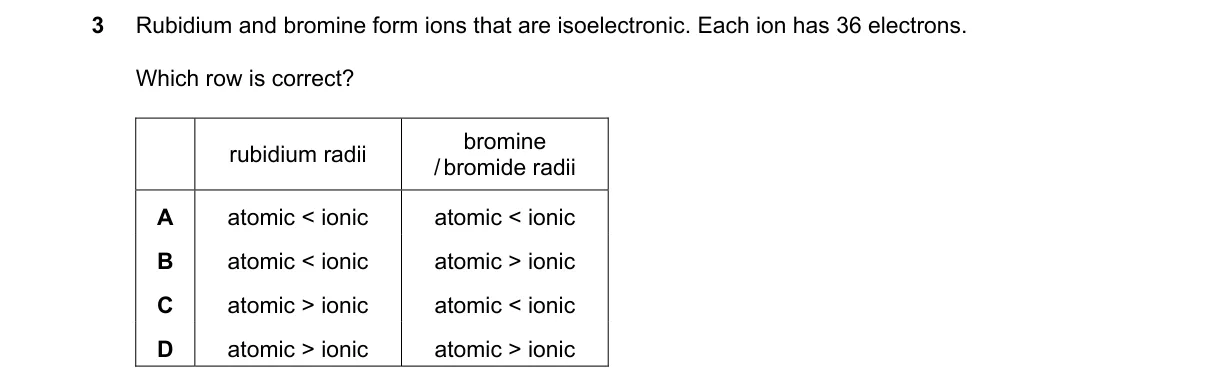
Answer choices
- Arubidium ion: atomic < ionic; bromide ion: atomic > ionic
- Brubidium ion: atomic < ionic; bromide ion: atomic < ionic
- Crubidium ion: atomic > ionic; bromide ion: atomic > ionic
- Drubidium ion: atomic > ionic; bromide ion: atomic < ionic
Explanation
Ionic vs. Atomic Radii for Cations and Anions
Steps:
- Rb (Z=37) forms Rb⁺ by losing 1 electron (36 electrons); Br (Z=35) forms Br⁻ by gaining 1 electron (36 electrons).
- Cations like Rb⁺ have higher effective nuclear charge, shrinking the radius compared to neutral Rb atom.
- Anions like Br⁻ have lower effective nuclear charge per electron, expanding the radius compared to neutral Br atom.
- Thus, Rb atomic radius > Rb⁺ ionic radius; Br atomic radius < Br⁻ ionic radius.
Why D is correct:
- Cations are smaller than parent atoms due to increased effective nuclear charge; anions are larger due to electron repulsion (standard periodic trend).
Why the others are wrong:
- A: Incorrectly states Rb atomic < ionic (cations shrink) and Br atomic > ionic (anions expand).
- B: Falsely claims both atomic < ionic, ignoring cation shrinkage.
- C: Wrongly applies atomic > ionic to Br⁻, where anion expansion occurs.
Final answer: D
Topic: The Periodic Table: chemical periodicity
Practice more A Levels Chemistry (9701) questions on mMCQ.me