A Levels Chemistry (9701)•9701/12/O/N/18
A Levels Chemistry (9701) — 9701/12/O/N/18, Question 24
Which statement about compound Q is correct?
CH3-C(O)-CH2-CH3
Q
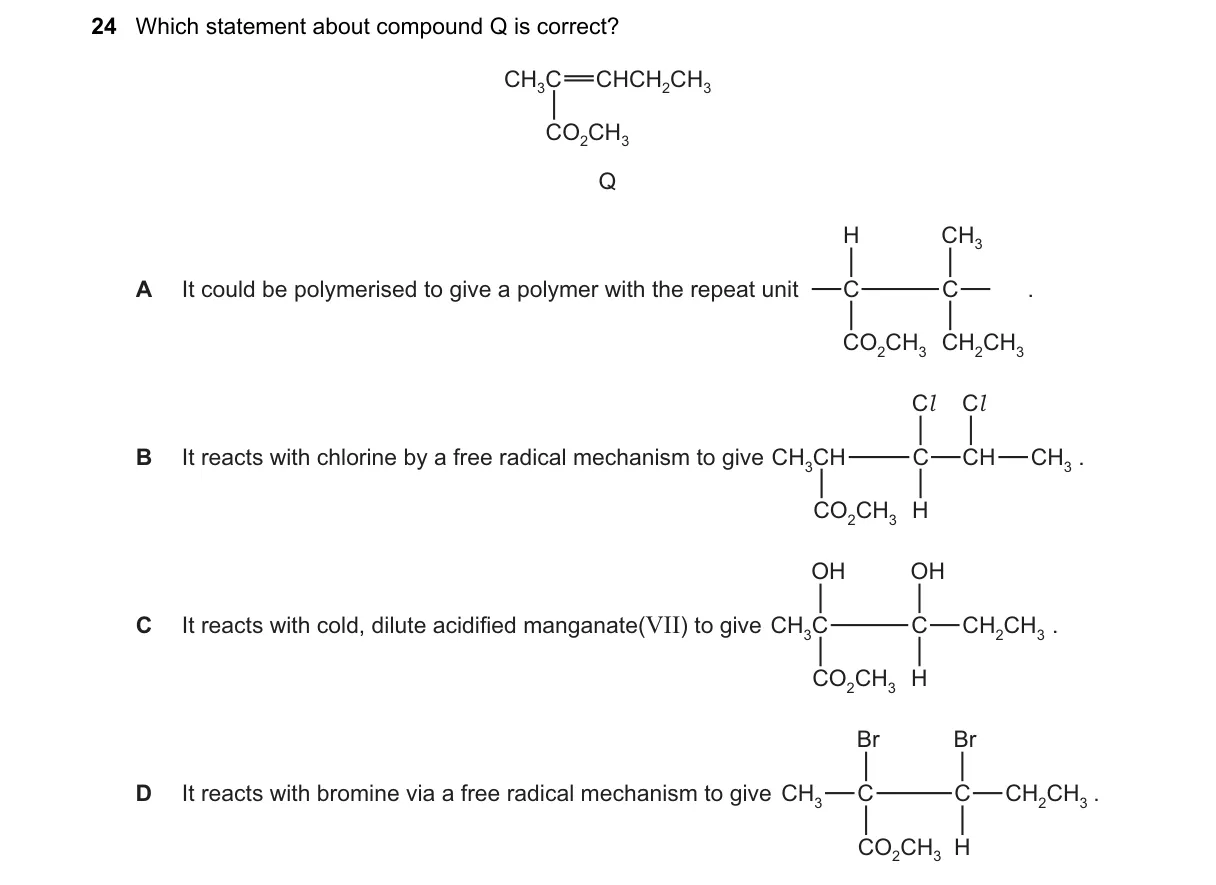
Answer choices
- AIt could be polymerised to give a polymer with the repeat unit CH2-CH(CO-CH3)
- BIt reacts with chlorine by a free radical mechanism to give CH3-C(O)-CHCl-CH3
- CIt reacts with cold dilute acidified manganate(VII) to give CH3-C(O)-CH2-CH2OH
- DIt reacts with bromine via a free radical mechanism to give CH3-C(O)-CHBr-CH3
Explanation
Mild oxidation of butan-2-one with KMnO₄ Steps:
- Identify Q as butan-2-one, CH₃C(O)CH₂CH₃, an unsymmetrical ketone.
- Note cold, dilute, acidified manganate(VII) acts as a mild oxidant targeting the terminal methyl in the ethyl group.
- Oxidation converts -CH₂CH₃ to -CH₂CH₂OH, preserving the carbonyl.
- Resulting product CH₃C(O)CH₂CH₂OH matches option C. Why C is correct:
- Cold, dilute, acidified KMnO₄ selectively oxidizes the primary carbon in the alkyl chain of methyl ketones to a primary alcohol, per standard organic oxidation rules. Why the others are wrong:
- A: Butan-2-one has no C=C bond for addition polymerization; repeat unit suggests vinyl monomer like methyl acrylate.
- B: Alpha-chlorination of ketones uses electrophilic mechanism with Cl₂/acid, not free radical.
- D: Alpha-bromination of ketones is electrophilic, not free radical with Br₂. Final answer: C
Topic: Carbonyl compounds
Practice more A Levels Chemistry (9701) questions on mMCQ.me