A Levels Chemistry (9701)•9701/12/O/N/18
A Levels Chemistry (9701) — 9701/12/O/N/18, Question 13
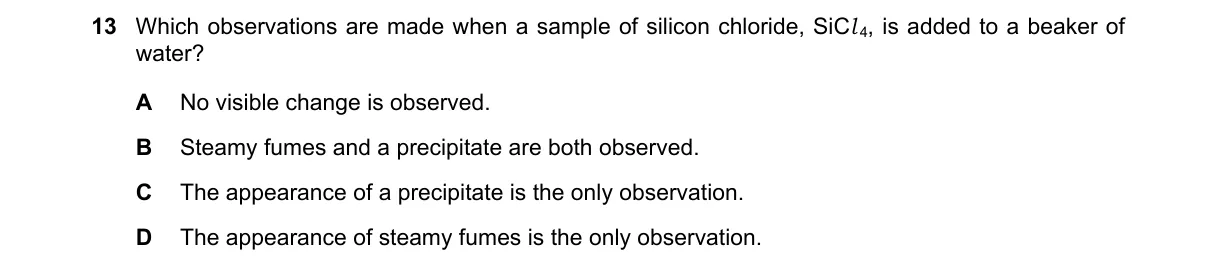
Which observations are made when a sample of silicon chloride, SiCl, is added to a beaker of water?
Answer choices
- ANo visible change observed.
- BSteamy fumes and a precipitate are both observed.
- CThe appearance of a precipitate is the only observation.
- DThe appearance of steamy fumes is the only observation.
Explanation
Hydrolysis of silicon chloride with water Steps:
- Silicon chloride (SiCl₄) reacts with water to undergo hydrolysis.
- The reaction is SiCl₄ + 4H₂O → Si(OH)₄ + 4HCl.
- HCl produced forms steamy fumes due to its reaction with atmospheric moisture.
- Si(OH)₄ (silicic acid) forms a white gelatinous precipitate.
Why B is correct:
- Hydrolysis equation shows both HCl (steamy fumes) and Si(OH)₄ (precipitate) form simultaneously.
Why the others are wrong:
- A: Reaction is vigorous with visible changes, not inert.
- C: Ignores steamy fumes from HCl evolution.
- D: Ignores precipitate from silicic acid formation.
Final answer: B
Topic: The Periodic Table: chemical periodicity
Practice more A Levels Chemistry (9701) questions on mMCQ.me