A Levels Chemistry (9701)•9701/11/O/N/18
A Levels Chemistry (9701) — 9701/11/O/N/18, Question 30
J is a branched-chain alcohol, C4H9OH. J is heated under reflux with an excess of Cr2O7^2-/H+ until no further reaction occurs. The infra-red spectrum of K is shown. What are the structures of the branched-chain alcohol J and compound K?
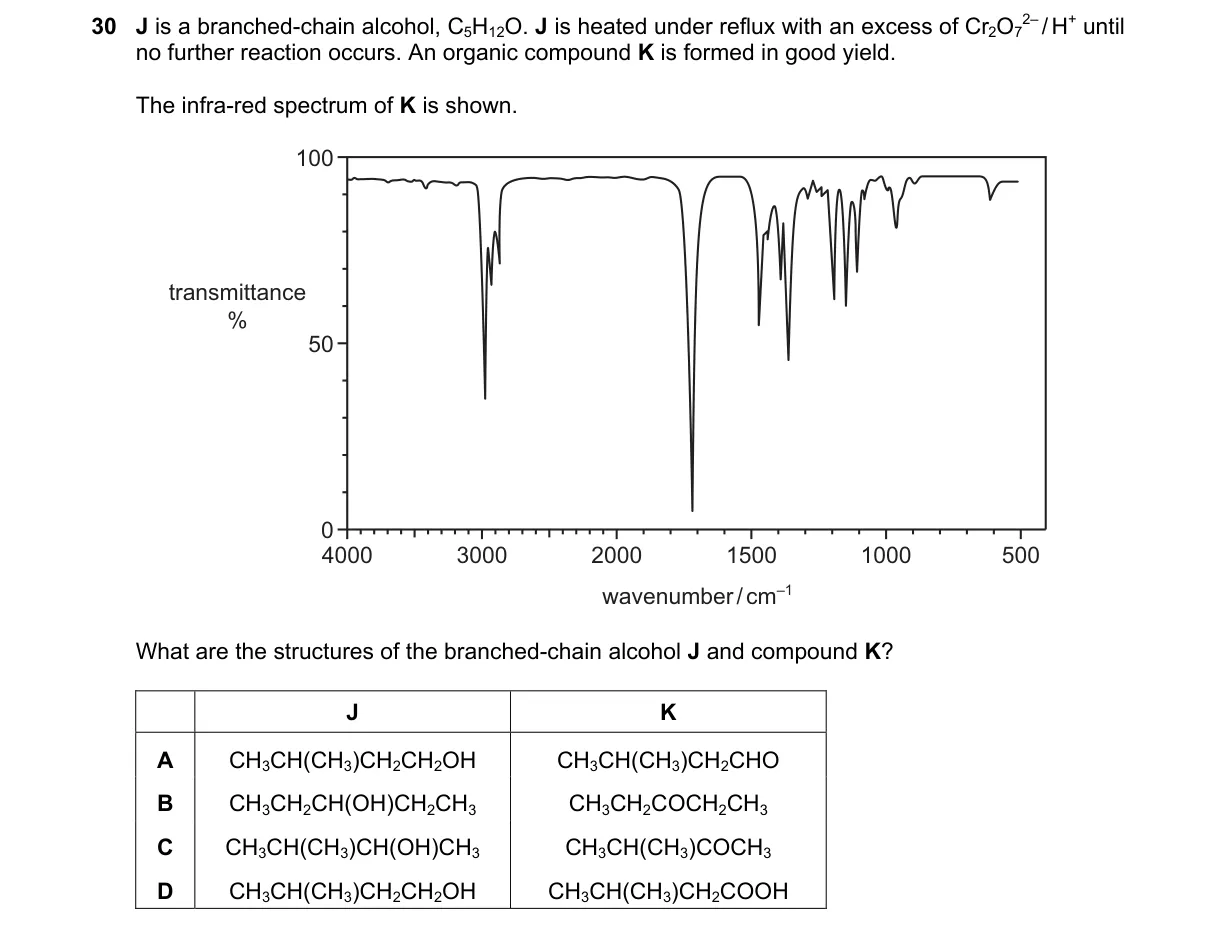
Answer choices
- ACH3CH(CH3)CH2OH, CH3CH(CH3)CHO
- BCH3CH2CH(OH)CH3, CH3C(O)CH2CH3
- CCH3CH(CH3)CH2OH, CH3CH(CH3)COOH
- DCH3CH(CH3)CH2OH, CH3CH(CH3)COOCH3
Explanation
Primary alcohol oxidation to carboxylic acid under excess conditions
Steps:
- Identify J as branched C4H9OH: options A, C, D share CH3CH(CH3)CH2OH (2-methylpropan-1-ol, primary); B is straight-chain secondary (butan-2-ol).
- Excess Cr2O7^2-/H+ reflux oxidizes primary alcohols fully to carboxylic acids, stopping at ketones for secondary.
- K's IR (implied) shows carboxylic acid features (broad O-H ~3000 cm⁻¹, C=O ~1710 cm⁻¹), not aldehyde, ketone, or ester.
- Match: J oxidizes to CH3CH(CH3)COOH, fitting branched primary alcohol and IR.
Why C is correct:
- Primary alcohols with excess dichromate oxidize to RCOOH (formula: 3RCH2OH + Cr2O7^2- + 8H+ → 3RCOOH + 2Cr^3+ + 7H2O), confirmed by IR's broad O-H and lowered C=O stretch.
Why the others are wrong:
- A: Product is aldehyde (stops early without excess/distillation; IR lacks broad O-H).
- B: Alcohol is unbranched; product is ketone (IR shows sharp C=O ~1715 cm⁻¹, no O-H).
- D: Product is ester (requires acid + alcohol, not oxidation; IR shows C=O ~1735 cm⁻¹, C-O ~1100 cm⁻¹).
Final answer: C
Topic: Hydroxy compounds
Practice more A Levels Chemistry (9701) questions on mMCQ.me