A Levels Chemistry (9701)•9701/11/O/N/18
A Levels Chemistry (9701) — 9701/11/O/N/18, Question 23
The conversion of propane to propan-1-ol can be carried out in stages represented by the equations shown. reaction 1 CH3CH2CH3(g) + HI(g) → CH3CH2CH2I(aq) + ? reaction 2 CH3CH2CH2I + KOH(aq) → CH3CH2CH2OH(aq) + K+(aq) + I-(aq) How can these reactions be described?
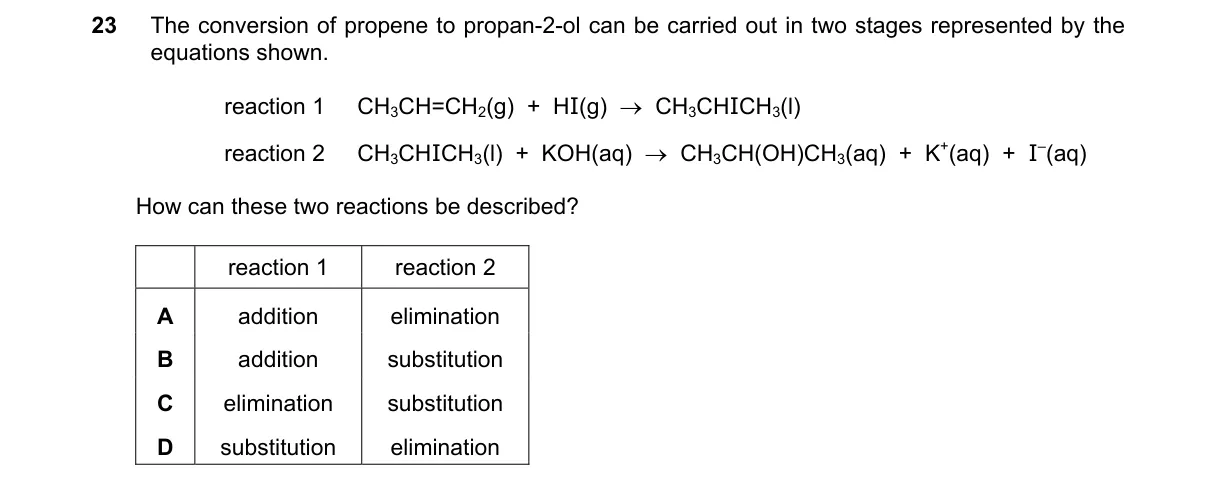
Answer choices
- Aaddition elimination
- Baddition substitution
- Celimination substitution
- Dsubstitution elimination
Explanation
Classifying organic reaction types in multi-stage synthesis
Steps:
- Analyze reaction 1: CH₃CH₂CH₃ + HI → CH₃CH₂CH₂I + ?, where HI adds to the propane molecule, forming the alkyl iodide product, classifying it as addition.
- Note the ? likely represents H₂ or byproduct, consistent with addition across C-H.
- Analyze reaction 2: CH₃CH₂CH₂I + KOH(aq) → CH₃CH₂CH₂OH + K⁺ + I⁻, where OH⁻ replaces I⁻ via nucleophilic attack, classifying it as substitution.
- Combine types: first addition, then substitution, matching option B.
Why B is correct:
- Addition involves HI adding to propane to form C-I bond; substitution follows SN mechanism per IUPAC, replacing halogen with OH in aqueous base.
Why the others are wrong:
- A: Second reaction is substitution, not elimination (no alkene formed; aq KOH favors SN over E).
- C: First reaction is addition, not elimination (no loss of small molecule like H₂O/HX to form double bond).
- D: First reaction is addition, not substitution (no direct atom replacement without addition step).
Final answer: B
Topic: Halogen compounds
Practice more A Levels Chemistry (9701) questions on mMCQ.me