A Levels Chemistry (9701)•9701/11/O/N/18
A Levels Chemistry (9701) — 9701/11/O/N/18, Question 17
Reaction 1: Chlorine reacts with cold aqueous sodium hydroxide to form Z. Reaction 2: Z is heated and forms ClO-(aq) and Cl-(aq). Which equations represent reaction 1 and reaction 2?
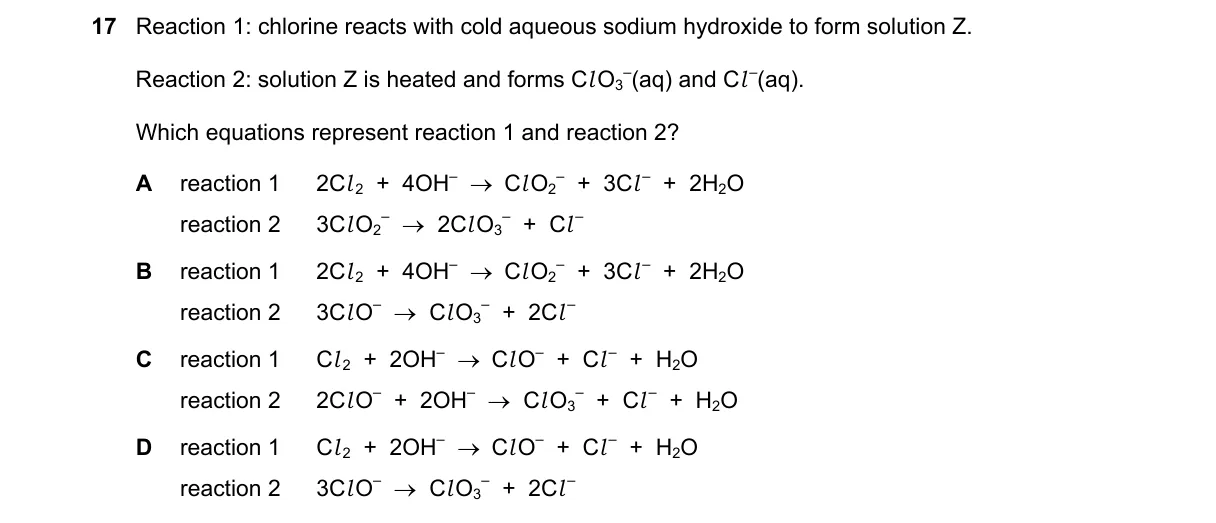
Answer choices
- Areaction 1 2Cl2 + 2OH- → ClO- + Cl- + 2H2O reaction 2 3ClO- → 2Cl- + ClO3-
- Breaction 1 3Cl2 + 6OH- → 5Cl- + ClO3- + 3H2O reaction 2 ClO- → ClO3- + Cl- + H2O
- Creaction 1 Cl2 + 2OH- → ClO- + Cl- + H2O reaction 2 3ClO- → ClO3- + 2Cl-
- Dreaction 1 Cl2 + 2OH- → ClO- + Cl- + H2O reaction 2 3ClO- → ClO- + Cl- + H2O
Explanation
Chlorine Disproportionation in Alkaline Conditions
Steps:
- Reaction 1 with cold NaOH: Cl₂ disproportionates to hypochlorite (ClO⁻) and chloride (Cl⁻), so Z is ClO⁻; equation is Cl₂ + 2OH⁻ → ClO⁻ + Cl⁻ + H₂O.
- Reaction 2: Heating Z (ClO⁻) causes further disproportionation to chlorate (ClO₃⁻) and Cl⁻; equation is 3ClO⁻ → ClO₃⁻ + 2Cl⁻ (assuming question intends ClO₃⁻, not ClO⁻, as latter mismatches chemistry).
- Eliminate choices with incorrect reaction 1 (hot NaOH or unbalanced).
- Select choice matching both standard equations.
Why C is correct:
- Equations follow established disproportionation formulas for cold NaOH (hypochlorite formation) and hypochlorite heating (chlorate formation).
Why the others are wrong:
- A: Reaction 1 stoichiometry wrong (2Cl₂ + 2OH⁻ unbalanced, produces excess Cl).
- B: Reaction 1 for hot concentrated NaOH (forms ClO₃⁻ directly); reaction 2 unbalanced and incorrect products.
- D: Reaction 2 unbalanced (charge/O atoms mismatch) and wrong products (no ClO₃⁻).
Final answer: C
Topic: Group 17
Practice more A Levels Chemistry (9701) questions on mMCQ.me