A Levels Chemistry (9701)•9701/11/O/N/18
A Levels Chemistry (9701) — 9701/11/O/N/18, Question 11
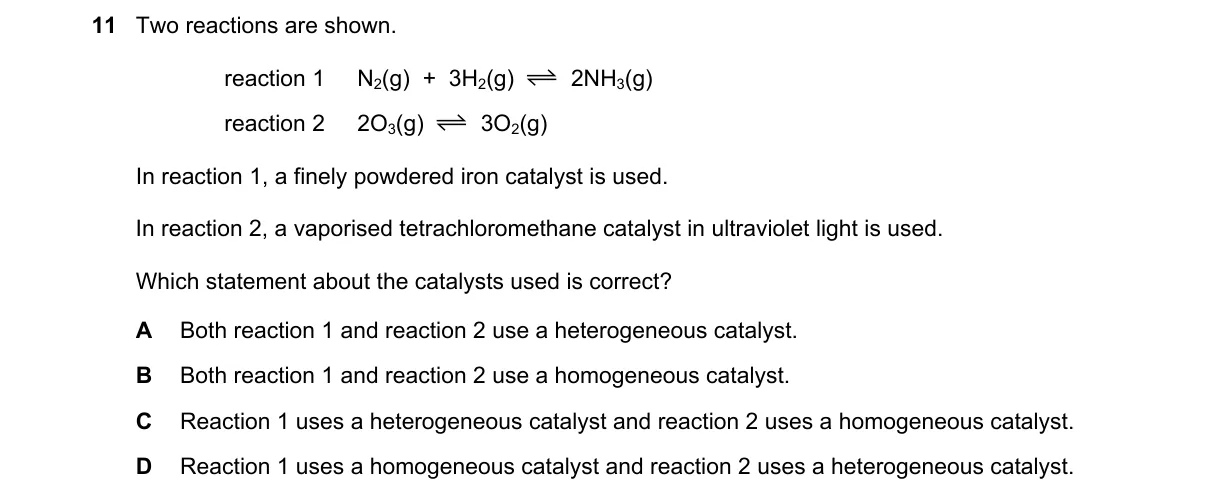
Two reactions are shown. Reaction 1: N2(g) + 3H2(g) → 2NH3(g) In reaction 1, a finely divided Fe(s) is used. In reaction 2, a vaporized tetrachloroethane catalyst is used in ultraviolet light. Which statement about the catalysts used is correct?
Answer choices
- ABoth reaction 1 and reaction 2 use a heterogeneous catalyst.
- BBoth reaction 1 and reaction 2 use a homogeneous catalyst.
- CReaction 1 uses a heterogeneous catalyst and reaction 2 uses a homogeneous catalyst.
- DReaction 1 uses a homogeneous catalyst and reaction 2 uses a heterogeneous catalyst.
Explanation
Catalysts: Heterogeneous vs. Homogeneous
Steps:
- Define heterogeneous catalyst as one in a different phase from reactants (e.g., solid with gases); homogeneous as same phase (e.g., all gases).
- Analyze reaction 1: Fe(s) is solid catalyst, N2(g) and H2(g) are gases, so different phases—heterogeneous.
- Analyze reaction 2: Vaporized tetrachloroethane is gaseous catalyst under UV light, implying gaseous reactants (photochemical process), so same phase—homogeneous.
- Match to options: Reaction 1 heterogeneous, reaction 2 homogeneous, selecting C.
Why C is correct:
- Heterogeneous catalysts differ in phase from reactants (Fe solid vs. gases); homogeneous match phases (vaporized catalyst with likely gaseous reactants).
Why the others are wrong:
- A: Reaction 2 uses homogeneous catalyst, not heterogeneous.
- B: Reaction 1 uses heterogeneous catalyst, not homogeneous.
- D: Reverses the catalyst types for each reaction.
Final answer: C
Topic: Reaction kinetics
Practice more A Levels Chemistry (9701) questions on mMCQ.me