A Levels Chemistry (9701)•9701/14/M/J/25
A Levels Chemistry (9701) — 9701/14/M/J/25, Question 38
Separate samples of 1-bromopropane are used in two different reactions. Reaction 1: 1-bromopropane is converted into compound X by heating it under pressure with ammonia in ethanol. Reaction 2: 1-bromopropane is converted into compound Y. Compound Y undergoes hydrolysis to form butanoic acid. Which row identifies compound X and describes the reagents used in reaction 2 to make compound Y?
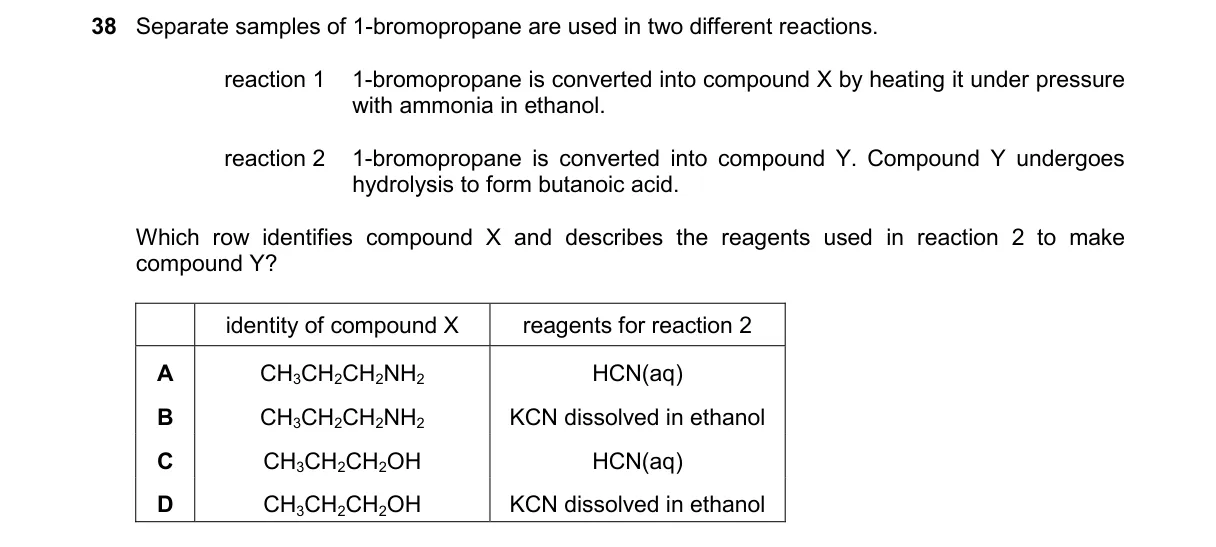
Answer choices
- ACH₃CH₂CH₂NH₂ KCN dissolved in ethanol
- BCH₃CH₂CH₂NH₃⁺ KCN [Naq]
- CCH₃CH₂CH₂OH HCN[Naq]
- DCH₃CH₂CH₂OH KCN dissolved in ethanol
Explanation
Nucleophilic substitution products from 1-bromopropane
Steps:
- Reaction 1 with NH₃ in ethanol forms the ammonium salt CH₃CH₂CH₂NH₃⁺ Br⁻ as compound X, since NH₃ initially substitutes Br⁻ to give the protonated amine.
- Reaction 2 produces Y, which hydrolyses to butanoic acid (CH₃CH₂CH₂COOH), so Y is butanenitrile (CH₃CH₂CH₂CN) via CN⁻ addition, extending the chain by one carbon.
- Reagents for Y: Aqueous KCN (or NaCN) enables SN2 substitution to form the nitrile without alcohol solvent interference.
- Choice B matches X as CH₃CH₂CH₂NH₃⁺ and reaction 2 reagents as KCN [Naq].
Why B is correct:
- Ammonia reaction yields the ammonium ion per the substitution mechanism: RBr + NH₃ → RNH₃⁺ Br⁻; aqueous KCN forms RCN, which hydrolyses to RCOOH + NH₃.
Why the others are wrong:
- A: X is free amine (not salt); KCN/EtOH works but doesn't match X.
- C: X is alcohol (wrong product; needs OH⁻, not NH₃); HCN/Naq is ineffective for substitution.
- D: X is alcohol (incorrect for NH₃ reaction); KCN/EtOH makes nitrile but mismatches X.
Final answer: B
Topic: Halogen compounds
Practice more A Levels Chemistry (9701) questions on mMCQ.me