A Levels Chemistry (9701)•9701/14/M/J/25
A Levels Chemistry (9701) — 9701/14/M/J/25, Question 34
Acidified potassium dichromate(VII), K2Cr2O7, is added to propan-1-ol and the mixture is refluxed. The distillate is treated with HCN in the presence of KCN. What is the organic product?
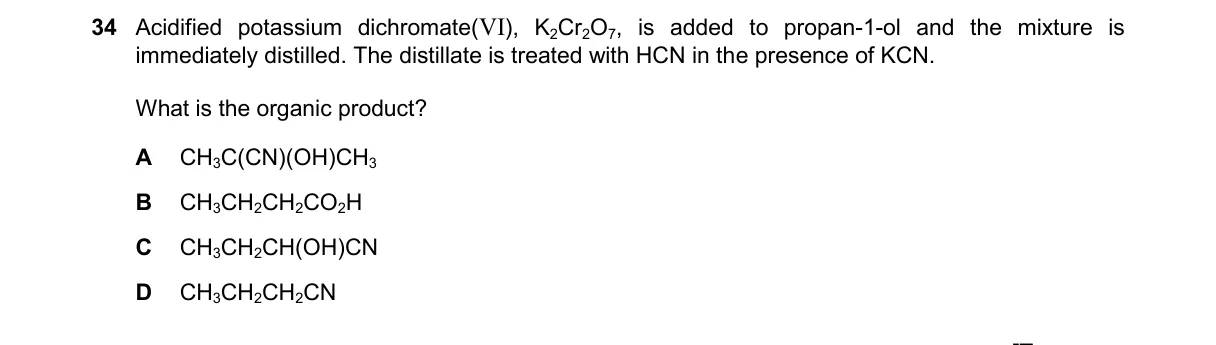
Answer choices
- ACH3CH(OH)CN
- BCH3CH2CH(OH)CN
- CCH3CH2CN
- DCH3CH2CH2CN
Explanation
Primary alcohol oxidation to aldehyde followed by cyanohydrin formation
Steps:
- Propan-1-ol, CH₃CH₂CH₂OH, is a primary alcohol oxidized by acidified K₂Cr₂O₇.
- Reflux typically gives carboxylic acid, but taking the distillate captures the volatile intermediate aldehyde, propanal (CH₃CH₂CHO), preventing further oxidation.
- The distillate, propanal, contains a carbonyl group reactive toward nucleophiles.
- HCN, generated in situ from KCN, adds across the C=O bond of propanal to form the cyanohydrin.
Why B is correct:
- Cyanohydrin formation follows the general reaction RCHO + HCN → RCH(OH)CN; for R = CH₃CH₂, the product is CH₃CH₂CH(OH)CN.
Why the others are wrong:
- A: Product from acetaldehyde (CH₃CHO) cyanohydrin, not propanal.
- C: Propanenitrile from amide dehydration or ethyl halide + CN⁻, not carbonyl addition.
- D: Butanenitrile from butanal cyanohydrin or propyl halide + CN⁻, one extra carbon.
Final answer: B
Topic: Organic synthesis
Practice more A Levels Chemistry (9701) questions on mMCQ.me