A Levels Chemistry (9701)•9701/13/M/J/25
A Levels Chemistry (9701) — 9701/13/M/J/25, Question 34
The reaction shown can be used to lengthen a carbon chain. CH3CH2Br + CN- → CH3CH2CN + Br- Which row shows the correct reagent and conditions for this reaction?
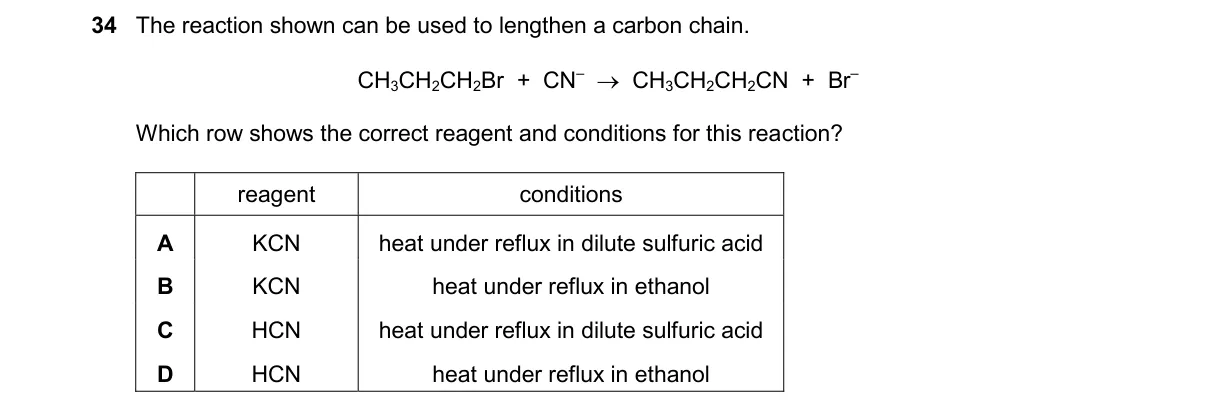
Answer choices
- AKCN heat under reflux in dilute alcohol
- BKCN heat under reflux in dilute sulfuric acid
- CHCN heat under reflux in dilute sulfuric acid
- DHCN heat under reflux in ethanol
Explanation
Nucleophilic substitution with cyanide for chain lengthening Steps:
- Identify reaction as SN2 on primary alkyl halide requiring CN⁻ nucleophile.
- Select reagent providing high CN⁻ concentration: KCN over HCN (weak acid, low dissociation).
- Choose solvent: polar protic like alcohol for SN2; avoid acids that protonate CN⁻ to HCN.
- Apply heat under reflux to ensure completion without loss of volatile products.
Why A is correct:
- KCN dissociates fully to CN⁻; dilute alcohol (ethanol) is polar protic solvent promoting SN2 per standard organic mechanisms.
Why the others are wrong:
- B: Dilute sulfuric acid protonates CN⁻ (CN⁻ + H⁺ → HCN), lowering nucleophile availability.
- C: HCN gives low CN⁻ concentration; sulfuric acid further suppresses ionization.
- D: HCN in ethanol maintains low CN⁻ levels, insufficient for efficient substitution.
Final answer: A
Topic: Halogen compounds
Practice more A Levels Chemistry (9701) questions on mMCQ.me