A Levels Chemistry (9701)•9701/13/M/J/25
A Levels Chemistry (9701) — 9701/13/M/J/25, Question 29
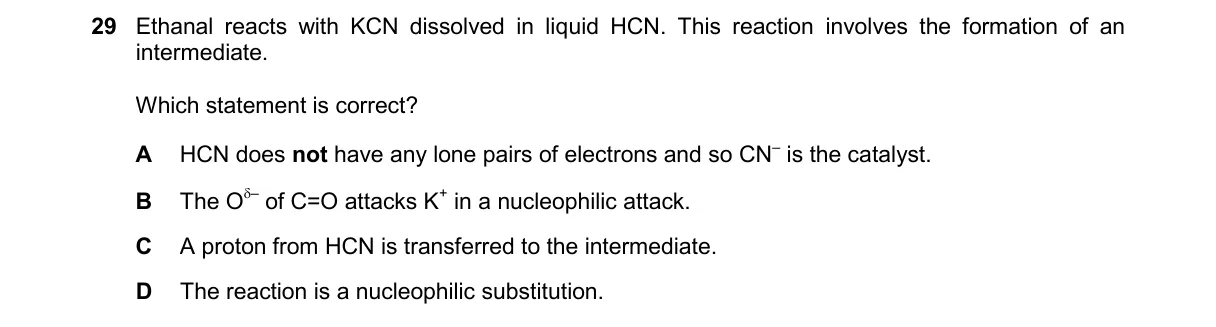
Ethanol reacts with KCN dissolved in liquid HCN. This reaction involves the formation of an intermediate. Which statement is correct?
Answer choices
- AHCN does not have any lone pairs of electrons and so CN- is the catalyst.
- BThe O- of CH3CH2O- K+ in a nucleophilic attack.
- CA proton from HCN is transferred to the oxygen of ethanol in a nucleophilic attack so CN- attacks.
- DThe reaction is a nucleophilic substitution.
Explanation
Protonation enables CN- nucleophilic attack on ethanol
Steps:
- Liquid HCN acts as acid, protonating oxygen of ethanol (CH3CH2OH) to form CH3CH2OH2+ intermediate.
- Protonation converts OH into good leaving group (H2O).
- CN- from KCN performs SN2 attack on carbon of protonated ethanol.
- Displacement of H2O yields ethyl cyanide (CH3CH2CN).
Why C is correct:
- Describes acid-base proton transfer from HCN to ethanol's oxygen, generating electrophilic intermediate for CN- nucleophilic attack, per SN2 mechanism requirements.
Why the others are wrong:
- A: HCN has lone pair on N (sp hybridized); CN- is nucleophile, not catalyst.
- B: No ethoxide (CH3CH2O-) forms; ethanol remains neutral and gets protonated, not deprotonated.
- D: True overall, but ignores key intermediate (protonated ethanol) and proton transfer step.
Final answer: C
Topic: Hydroxy compounds
Practice more A Levels Chemistry (9701) questions on mMCQ.me