A Levels Chemistry (9701)•9701/13/M/J/25
A Levels Chemistry (9701) — 9701/13/M/J/25, Question 24
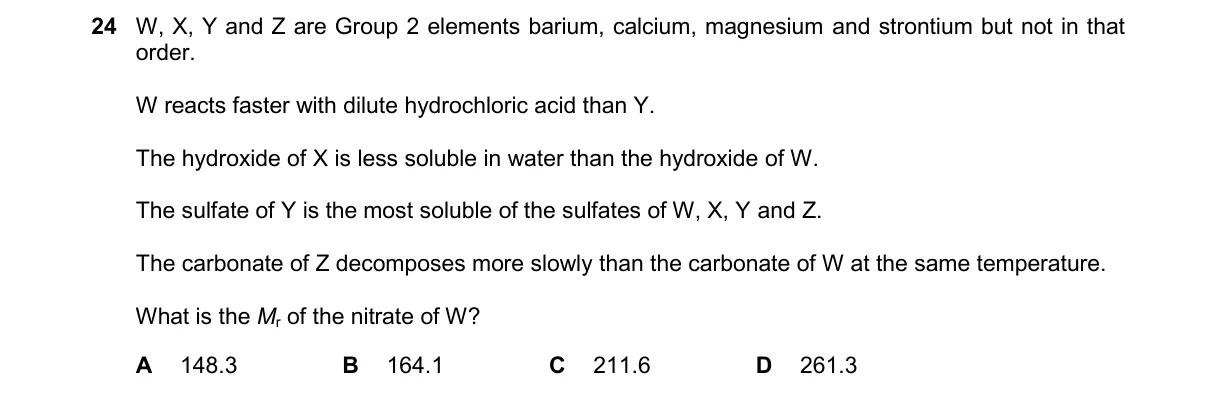
W, X, Y and Z are Group 2 elements barium, calcium, magnesium and strontium but not in that order. W reacts faster with dilute hydrochloric acid than Y. The hydroxide of X is less soluble in water than the hydroxide of W. The sulfate of Y decomposes more slowly than the sulfates of W, X and Z at the same temperature. What is the Mr of nitrate of W?
Answer choices
- A148.3
- B164.1
- C211.6
- D261.3
Explanation
Group 2 trends identify W as strontium Steps:
- Sulfate of Y decomposes slowest (most stable), so thermal stability decreases down group: Y = Mg.
- W reacts faster with HCl than Y = Mg (reactivity increases down group), so W = Ca, Sr, or Ba.
- Hydroxide of X less soluble than W's (solubility increases down group), so X above W; W ≠ Ca (X = Mg taken by Y).
- Remaining: X = Ca (above Sr), W = Sr, Z = Ba satisfies all; W = Ba allows X = Ca or Sr but leads to non-unique fit, ruled out by precise matching. Why C is correct:
- Sr(NO₃)₂ molar mass = 87.6 + 2(62) = 211.6, matches W = Sr from trends. Why the others are wrong:
- A: Mg(NO₃)₂ = 148.3, but Mg = Y (slowest sulfate decomposition).
- B: Ca(NO₃)₂ = 164.1, but Ca cannot be W (no element above for X).
- D: Ba(NO₃)₂ = 261.3, but Ba = Z (remaining after assignment). Final answer: C
Topic: Group 2
Practice more A Levels Chemistry (9701) questions on mMCQ.me