A Levels Chemistry (9701)•9701/13/M/J/25
A Levels Chemistry (9701) — 9701/13/M/J/25, Question 20
Three statements about the chemical periodicity of Period 3 oxides are listed. 1 The maximum oxidation state from sodium to phosphorus, then decreases from phosphorus to sulfur 2 The oxides from sodium to sulfur are hydrolysed by water without hydrolysis, from aluminum to sulfur they are hydrolysed by water 3 The structure and bonding changes from giant ionic to giant covalent to simple molecular Which statements are correct?
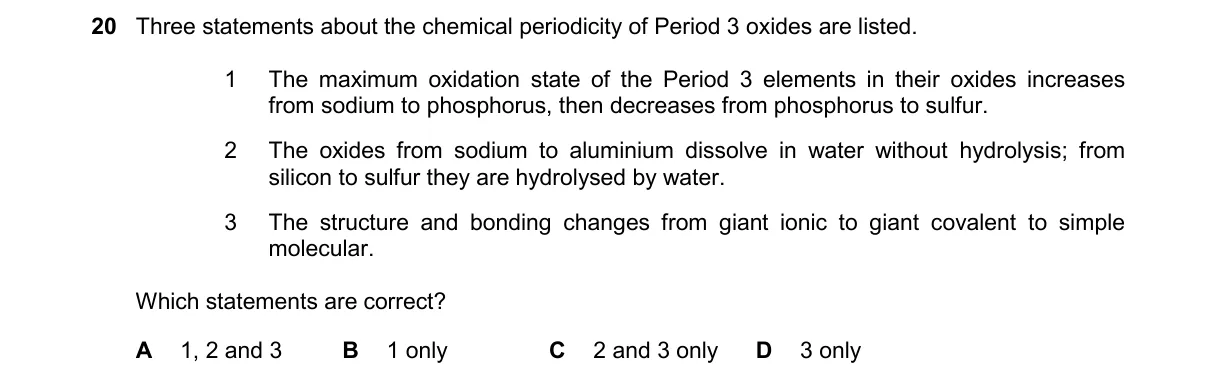
Answer choices
- A1, 2 and 3
- B1 only
- C2 and 3 only
- D3 only
Explanation
Period 3 Oxides: Structure and Reactivity Trends
Steps:
- Statement 1: Maximum oxidation states increase from Na (+1) to S (+6), contradicting the claimed decrease after P (+5).
- Statement 2: Wording is contradictory ("hydrolysed without hydrolysis"); actual hydrolysis varies (e.g., Na2O reacts, SiO2 inert), not matching the description.
- Statement 3: Bonding shifts correctly—giant ionic (Na2O, MgO), giant covalent (Al2O3, SiO2), simple molecular (P4O10, SO2/SO3).
- Only statement 3 aligns with periodic trends.
Why D is correct:
- D selects only statement 3, matching the established progression in oxide structures per periodic table group trends.
Why the others are wrong:
- A includes false statements 1 and 2.
- B relies solely on incorrect statement 1.
- C includes flawed statement 2.
Final answer: D
Topic: The Periodic Table: chemical periodicity
Practice more A Levels Chemistry (9701) questions on mMCQ.me