A Levels Chemistry (9701)•9701/13/M/J/25
A Levels Chemistry (9701) — 9701/13/M/J/25, Question 19
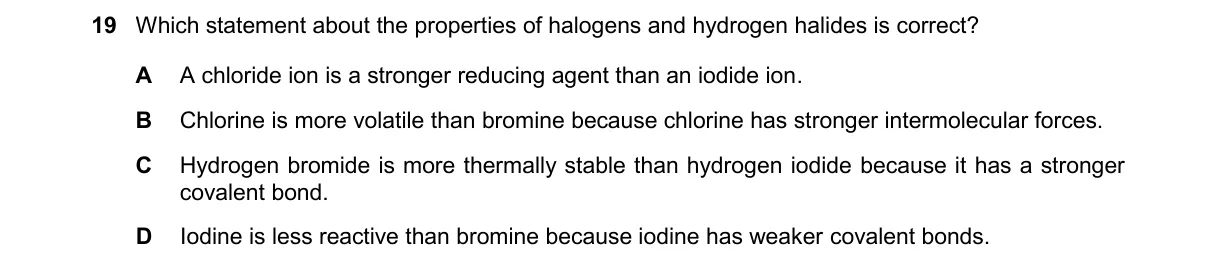
Which statement about the properties of halogens and hydrogen halides is correct?
Answer choices
- AChloride ion is a stronger reducing agent than iodide ion.
- BChlorine is more volatile than bromine because chlorine has stronger intermolecular forces.
- CHydrogen bromide is more thermally stable than hydrogen iodide because it has a stronger covalent bond.
- DIodine is less reactive than bromine because iodine has weaker covalent bonds.
Explanation
Thermal stability trends in hydrogen halides
Steps:
- Bond dissociation energy decreases down group 17: H-F > H-Cl > H-Br > H-I.
- Weaker H-I bond leads to lower thermal stability for HI compared to HBr.
- Evaluate options: A reverses reducing strength; B misstates volatility cause; C matches bond trend; D confuses reactivity factors.
- Confirm C aligns with bond energy data showing H-Br (366 kJ/mol) > H-I (298 kJ/mol).
Why C is correct:
- Thermal stability of H-X increases with H-X bond strength, per bond dissociation energy formula, making HBr more stable than HI.
Why the others are wrong:
- A: Iodide ion is stronger reducing agent than chloride due to easier I- to I2 oxidation.
- B: Chlorine is more volatile than bromine from weaker London dispersion forces, not stronger.
- D: Iodine's lower reactivity stems from weaker I2 oxidizing power, not just covalent bond weakness.
Final answer: C
Topic: Group 17
Practice more A Levels Chemistry (9701) questions on mMCQ.me