A Levels Chemistry (9701)•9701/13/M/J/25
A Levels Chemistry (9701) — 9701/13/M/J/25, Question 11
BF₃ reacts with NH₃ to form a single compound with simple molecular structure. BF₃ + NH₃ → F₃B-NH₃ Which describes how the F-B-F and H-N-H bond angles change during the reaction?
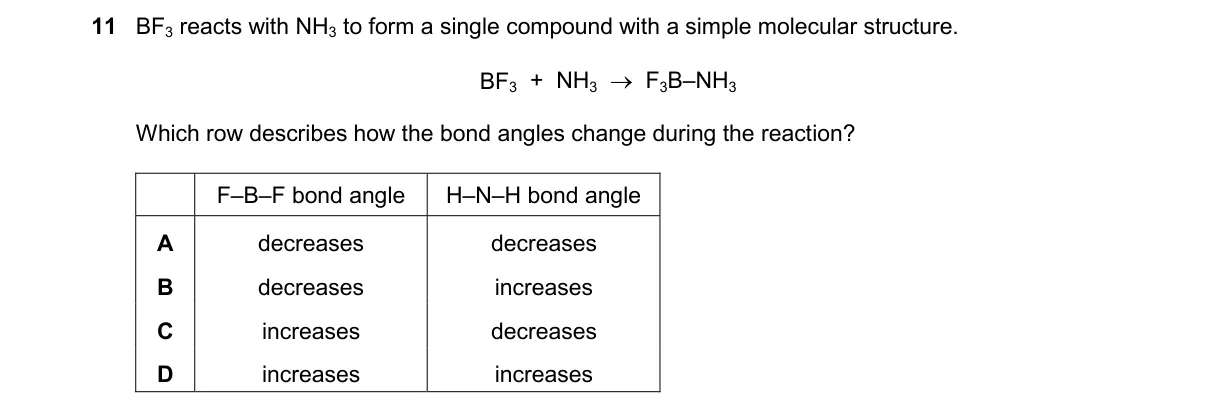
Answer choices
- AF-B-F bond angle decreases, H-N-H bond angle increases
- BF-B-F bond angle decreases, H-N-H bond angle decreases
- CF-B-F bond angle increases, H-N-H bond angle decreases
- DF-B-F bond angle increases, H-N-H bond angle increases
Explanation
Bond angle changes from hybridization and steric effects in adduct formation
Steps:
- BF₃ features sp² boron in trigonal planar geometry with F-B-F at 120°.
- NH₃ has sp³ nitrogen in trigonal pyramidal geometry with H-N-H at ~107°.
- Adduct formation coordinates N lone pair to empty B orbital, making B sp³ and tetrahedral, reducing F-B-F to ~109°.
- At nitrogen, four bonds form (3H + B); BF₃ bulk exceeds lone pair space, compressing H-N-H to ~106°.
Why B is correct:
- Matches VSEPR theory: sp² to sp³ at B decreases angle via increased repulsion; steric crowding at N decreases H-N-H per experimental data.
Why the others are wrong:
- A: H-N-H decreases, not increases, due to BF₃ bulk.
- C: F-B-F decreases from 120° to 109°, not increases.
- D: Neither angle increases; both compress.
Final answer: B
Topic: Chemical bonding
Practice more A Levels Chemistry (9701) questions on mMCQ.me